
(406) 206-7571
I’ve seldom witnessed a time when information was so unreliable.
We spend a phenomenal amount of time and resources focused on understanding what is happening around the world that may affect the stock market and other areas of our clients’ financial lives. We’ve always employed an intensely disciplined approach to review sources from various perspectives, comparing headline reports to primary sources of information, and doing our best to identify and challenge our personal biases. What seems crazy to us, is that nearly all of the information we come across, regardless of the source, has been wildly skewed and is propagandized to one side or the other. Naturally you’ll read this first as saying the other side is spreading misinformation, but it’s your side too.
Misinformation is baked into the data as well. We’ve again seen more substantive downward revisions of economic data, and it feels as though politicians and pundits have realized they can blast the most miniscule (and often irrelevant) information in memes across social media to manipulate public perspective. Again, all sides are doing this and if we truly want to understand the world around us, we must look first at the ways our own biases and groupthink can cause us to misinterpret reality. None of this is even touching the new reality that AI can fabricate all kinds of believable fakes (I’m not claiming everything is a deep fake, but I have access to AI video and audio tools, and it is alarmingly easy to do).
So what then, can we believe?
Businesses are run by people who are carefully working to create products and services for people who need them, and they aren’t doing it passively. They adapt to consumer demands, changing costs, new technologies, and economic conditions. They have a profit motive, and the end goal is to reward their owners in the form of a dividend payment. So, we invest by owning businesses that have been successful at this for many years. When we have a long-term perspective, these types of investments work very well and eliminate the need to obsess over market timing (which always hurts more than it helps).
It’s important to have the appropriate amount of cash in your portfolio. How much depends a great deal on your personal situation, but insufficient cash can force you to sell investments at a temporary loss that you otherwise wouldn’t sell. In our portfolios, we manage this dynamically depending on the magnitude of potential risks we see on the horizon (as those appear more significant, we tend to have more cash in portfolios). Having the right amount of cash in a portfolio also allows us to take advantage of opportunities as they arise.
We can diligently diversify risk across various industries, business, and service models while avoiding low-quality and high-risk investments (“index” investing really diversifies the high-risk, momentum stocks with lower-quality investments you wouldn’t intentionally buy). We can measure our effectiveness at this in a granular way and pay attention to the specific business, political, and economic risks that could hurt the business (tariffs are a great example here). A tariff on a specific product may heavily impact one business and have a negligible impact on a business not impacted by that product. Investments aren’t all the same, so it is important to invest in them on their own merits. For CoCreate clients, we fully manage this process for you.
We can believe that the only way we can fix the challenges in our society is to begin loving our neighbor, especially those who are different from us. We can’t expect the pundits and politicians to stop exploiting our polarized perspectives. We have to fix that on our own, in a grassroots groundswell of love, forgiveness, and humility. So as you’re watching headlines about anything going on in the world, remember that if you expect the worst from people, you’re guaranteed to get it, but if you open yourself up to look for the best in people, you’ll be surprised by how much you’ll find.
Military Operations in IRAN
I hate war, but I also hate mass murder. I’m confident nuclear weapons are destructive, especially in the hands of violent people. I’m amazed that the most dominant conversation around the conflict in Iran has been about gas prices rather than the millions of people tortured and murdered by the Ayatollah over the past 50 years. We should all feel the gravity of many conflicting emotions about the events that are transpiring. We are praying for every human life and for true peace when the conflict resolves. I will do my best to keep my comments focused on issues that will affect the market and economy.
While we have little quality information to rely on, there are several key premises we should be able to rely upon:
We are presently watching the start of a two-week ceasefire. The basis of the ceasefire agreement is unclear across various sources, and we are already seeing officials talking about where or not it has been broken. We would expect to see some of this in a cease-fire negotiation, but it underscores the reality that, from a market perspective, we must consider the conflict to be ongoing until peace is sustainable for the longer term.
Extended Bull Market and Slowing Economic Expansion
You can measure bull markets (growing stock market) and bear markets (declining stock market) in a variety of ways, and different commentators will mark the start and end of a bull market differently. In short, the stock market has been growing ever since the bottom of the great recession in 2009.

It’s been an exceptional bull market driven by a technological revolution that has changed life as we know it. These tend to last about 17 years before there is a meaningful correction in the markets. This isn’t a rule, of course, but we’re on year 17 and there are a mix of reasons to be excited about the future of the economy and things we should find quite concerning. In both cases, you want to be meaningfully invested in the stock market, because over time, these appear more like blips on the radar than financial catastrophes (they become catastrophic when you try to play them to your advantage. Inevitably, you end up selling at the worst time and buying back in when it’s too late). At the same time, we are becoming more defensive in our portfolios as many industry-specific risks and broader stock market risks increase. The S&P500 (which most people use to represent the “stock market” broadly… we think that’s fallacious, but that’s a conversation for another time), looks like it is beginning to form a rounded top. This tends to happen at the end of these secular bull markets as people begin to become concerned about the prospects of future growth. When we do this type of “technical analysis,” we need to be careful not to give it too much weight because it could mean something, it could mean nothing, or it could look entirely different tomorrow. As we are looking at the broader spectrum of data, it can sometimes be helpful.
The end of this secular bull market also doesn’t necessarily mean an impending stock market crash. There are many scenarios (some of which already appear to be playing out) which could avoid a broad-based market correction. We need to be strategic here, avoiding the major risks while maintaining well thought out investments in businesses that have a real basis for their value (i.e. healthy/growing profits combined with a long history of rising dividends).

Data Indicates Strain on the Economy
Artificial Intelligence
We’re continuing to monitor the investment environment around Artificial Intelligence. In short, we’re still seeing an AI bubble. There is good and bad at this point (which is a slight improvement over only bad). The good news is that we are finally beginning to see AI implemented in ways that can yield significant productivity gains, while at the same time, protecting your own Intellectual Property and private data is becoming easier (I can train and run my own Large Language Model right on my laptop). As I see it, there are things AI will never be able to do, but things that AI can do exceptionally well. The most economically significant development at present is the ability to easily program custom solutions and/or integrations so that information and systems that have been cumbersome and fragmented can be accessed more efficiently across teams. I believe this will be the first wave of AI usage that creates widespread return on investment.
Despite the continued development of AI, the issues with investment in AI related business persist. Valuations (though AI stock prices have decreased, making values a little better than a few months ago), are still off the charts and demand massive new revenue to justify the current prices. The values are driven by a circularity problem with the major AI investors. JP Morgan analyst, Michael Cembalest, explained this issue clearly last October:
“Oracle’s stock jumped by 25% after being promised $60 billion a year from OpenAI, an amount of money OpenAI doesn’t earn yet, to provide cloud computing facilities that Oracle hasn’t built yet, and which will require 4.5 GW of power (the equivalent of 2.25 Hoover Dams or four nuclear plants), as well as increased borrowing by Oracle whose debt to equity ratio is already 500% compared to 50% for Amazon, 30% for Microsoft and even less at Meta and Google. In other words, the tech capital cycle may be about to change.”
Essentially, there are massive investments being made by the big AI companies and reciprocal investments being made into the big AI companies, all without the support of any meaningful profit from the AI-related activities. It’s been massive corporate FOMO (fear of missing out). We still need to see enough revenue coming from AI business to justify investment in AI at the present time. Without that revenue, there is no basis by which we can expect anything but an AI crash.
Finally, the AI hyperscalers have been buying immense amounts of computing power (chips, data centers, etc.). Much of this will need to be replaced in the near future. According to McKinsey & Company, hyperscalers need to generate an additional $750 billion by 2030, just to account for the depreciation of this equipment. The combined profits of the hyperscalers are approximately $450 billion at present. These companies that are experiencing extreme values from the circularity issues also have a massive impending financial hurdle to overcome. Either the profits start showing, or the prices must come down much further so that they reflect these companies’ actual values.
Again, every business is not in crisis. We own many in our portfolios that are wildly profitable and are valued fairly (or even cheaply). We believe that now, more than any time in the past ~15 years, careful, intentional, long-term investment in profitable, dividend paying businesses matters. This simply can’t be accomplished by “index” investment, market timing, or many other common approaches. We are working hard to keep our client's portfolios profitable and prepared.
2026.03.16 Podcast Episode 2
Matt Hudak: Hi friends. My name is Matt Hudak. This is Christa Hudak. If you haven't had the chance to meet us, we're really excited that you are exploring CoCreate Financial and checking in on how we invest. That's what we'll be talking about today in our video. Just a little bit about our investment philosophies, how we approach each client's asset allocation, all those different things.
I promise we'll do it in plain English and it should make a ton of sense and hopefully inform your decision and our exploration process so that when we connect in person, we're able to focus more on the specific questions that you have, and less on just us talking at you about investment things that you probably don't even care about all that much.
So we're going to dive in and kind of talk about how we structure this.
Christa Hudak: Before we get into the specifics of talking about investments, the first thing we want to take a step back and consider is how we view a financial picture and making sure our clients have a setup that leads to their financial freedom.
And when we do that, you know, the very first base level that we always make sure with all of our clients is that they have appropriate cash reserves and then we bucket their assets. And this works both from the standpoint of cash management, of cash flow management, of just your regular income and also with your investment assets and how we approach it.
And we have this graphic that will show up on the screen as well that's something we use as we have this exploration for everyone. And the first thing that we always want to consider is that your basic needs are being met, right? So that you're paying your mortgage, you're able to eat reasonably, you're covering all the necessities in life.
And this is, like I said, true both for cash flow and then also when we're doing long-term planning and retirement planning, is that we really want to protect the chunk of your assets. And pay special attention that your basic needs are met throughout your life. But the reality is everybody, most everybody wants something a little bit more than just the bare minimum.
And we call that your adventure bucket. And this looks different for different people. Maybe it's living in a little bit nicer of a house or going out to eat or travel plans or all kinds of extravagant, fun things that we enjoy in life.
Matt Hudak: Yeah. It's the extras.
Christa Hudak: Yeah. That you're like, oh, I don't need this to live, but this is the thing that makes life fun.
And so we want to make sure we cover your basics. And then we also want to make sure that we're covering things that accomplish the things that you want to do in life. And somewhere in that range, there's what we call like enough. Sometimes people will talk about it as like a financial freedom line or a financial finish line of this recognition of, hey, I can be content at this level and satisfy the things that really matter to me, but that doesn't mean that that's all that there is to do, or maybe you have resources that exceed that. And so sometimes there's more adventure to be had. And then we also look at this idea of an impact bucket. And this can be the crazy projects or maybe it's a lot of gifting to family members or maybe some generosity of charitable giving.
Matt Hudak: Yeah, it might be pursuing business growth, a lot of those different pieces. So what does that look like in terms of when we're looking at somebody's assets, how much do we typically see in terms of need with that, like covering the basics to produce income, to cover your basic needs, what might that adventure bucket then look like beyond that?
Christa Hudak: Well, to be completely honest, this is very unique for everybody because we see a wide variety of just lifestyles and what people engage with and also different setups in it. There's different components in this that adjust those numbers both from the standpoint of what you are going to consume from it.
Maybe you just tend to live a simpler lifestyle and are very content with that. Or, also other income that comes in. So depending on what social security income looks like, or if somebody has pension income. The needs for those assets in that bucket to cover the basics goes down, but typically we see the basics and a little bit of adventure included when we have clients in the one to two million range with some additional income like we talked about. That's pretty typical.
Matt Hudak: Awesome. Yeah. And we'll fund that basics bucket typically with a portfolio of you know, dividend yielding stocks. We might fund that with some fixed income. We'll talk about what those things are in just a moment, but we'll look at really liquid, really secure things within the adventure bucket.
We'll probably look at more things like real estate rentals, those types of investments, they might be really stable income, except they've got some concentrated risk. You know, something goes wrong and the tenant doesn't pay. It's a big hit. So it's like they work well, but when they don't work, they really don't work for a period.
So we don't want to take those risks with your basic needs. But some of the adventure bucket, those [00:05:00] things kind of come into play there. And then in the impact bucket, we're looking at private equity and some impact investing sometimes like that. Things that can really do good in the world, solve hunger problems or human trafficking issues and make a profit at the same time.
So we look at all those different pieces but as you go up in those tiers, across those buckets, you have the ability to take some more strategic risks to accomplish great things because you're not needing those. But we also want to protect what you really need. So when we're doing that here's kind of what it looks like. There are a couple fundamental philosophies that we really hold to. We take a very business-minded approach to how we invest. So when you're looking at an investment with us, what we're doing is we're thinking about it like the business that we own.
The business that you, if you're a business owner and you own a business, we're thinking about the same way you would think about buying an individual business or making an individual loan or doing something like that. We make sure that we're really making smart decisions. The second thing that we've done is we've really taken a philosophy that clears [00:06:00] away a lot of the clutter from the complex investment products and the investment theories that really haven't added a lot of value to our ability to create returns in a portfolio.
They've added a lot of complexity. Some of them have added things that actually create new problems that we didn't have to deal with before, those types of theories. So we really take a very clean and simple approach that makes a lot of business sense.
Matt Hudak: And then we use a discipline process with that, and it allows us to maintain a laser focus on every investment that we own across our whole entire client asset base. And it actually allows us to measure things like diversification. It used to be that diversification was just owning everything and seeing what worked and what didn't, and you just kind of offset different types of things very generally, and it was a very kind of shorthand approach.
We take a very focused strategic approach where we can put numbers to this, and we audit that every month and debate that and discuss that as a team to make sure that we're appropriately managing our [00:07:00] client accounts at an investment level, at a very granular level, and we can specifically evaluate because of that, the specific business risks, the specific investment risks that exist with each investment, rather than just trying to monitor, you know, up and down fluctuation at the pricing in your account.
What's the actual risk that you have in that investment? What's the actual reward and how do we mitigate those strategically on a one-on-one level with each investment?
Christa Hudak: So Matt, do you want to back up and kind of show us how we view investments at their core?
Matt Hudak: Yeah, absolutely.
And we'll focus if it makes sense, we'll focus on just kind of this basics bucket, this more liquid style. When we get into the individual real estate properties, the private investments that someone might make, those are so individualized and they're so different from one to the next that we have to take a very focused approach in the context of our meeting, if that's you, but the first couple million dollars, like where we went, we were talking about will be in this basics bucket. So I'm going to go [00:08:00] ahead and pull up a whiteboard here and share this with you.
And kind of go through how we think about investing in general. So when you are making investments, it's not really owning markets or indexes or averages, it's not complex. It actually boils down to two things and there's kind of a third. That's the real estate side of things, but it fits kind of into the business ownership concept that we'll talk about.
The first thing that you can do is make loans.
I'm going to hold this because it's bouncing a little bit. So you can make loans and the other thing that you can do is you can own businesses. Own businesses. There we go. So when you're making a loan to somebody, I want you to think about this a lot like you're lending money to a friend. If you've done that at some point, or maybe even somebody that's not a friend, a random stranger, I don't know, that's one of the questions you have to ask.
If you're making this loan, think about what you're going to ask this person that you're lending to. You know, do they have a source of income to pay it back? What's the loan for?
Christa Hudak: When do they say they're going to pay it back?
Matt Hudak: Yeah. When do they say they're going to pay it back? Are they going to pay you interest?
Have you ever lent them money before? What do they do with it? Did they pay you back? All these questions we evaluate when we're looking at making loans as an investment. The only difference is you're making these investments to usually large corporations, governments and you're evaluating that on a case-by-case basis.
It's very different to make a loan to the city of Detroit than it is to the United States government than it is to Nigeria or to Coca-Cola. So it just depends on that mix. And we have to ask these questions. So what happens when you're making these loans is let's say it's the city of Bozeman, since we're located in Bozeman, and we're going to create an imaginary scenario here.
So the [00:10:00] city of Bozeman wants to lend money and they say, you know, if you give us a thousand dollars, 'cause they'll go to the public and do these incremental loans. So they'll say, if you give us a thousand dollars and let us keep it for 10 years, we're going to pay you a thousand dollars back in 10 years.
And that sounds like that'll work pretty well for, you know, keeping your thousand dollars stable. What I'll say is this thousand dollars, 10 years from now, isn't worth what a thousand dollars well by today it's, you know, a movie ticket used to cost and nickel kind of concept.
Christa Hudak: And Matt, what are they using this money for?
Matt Hudak: I don't know, maybe another high school. We could use a third one here in town.
Christa Hudak: Probably.
Matt Hudak: Yeah. So, in return for this, where you're going lend them the money, they're going pay you, let's say $60 a year. Okay? So that's 6% interest. If you're like me and struggle with math from time to time.
So, they're [00:11:00] going pay you $60 a year and that's going continue each of these 10 years until you get your principal back. Well, let's say in two years you want, and I don't know if there are 10 tick marks here, by the way, so don't count that. But if say in two years you need your principal back 'cause you want to buy a car or you want to do something fun, whatever it might be.
Well, if you go to the city of Bozeman at that point in time, they have no obligation to give you your money back. So they might just tell you to kick rocks. In fact, that's kind of generally what happens. So there's a system where if you want your thousand dollars back, you go out to the general market and it's a format.
It looks a lot like Craigslist but existed way longer than Craigslist has. But you go to this system where we post this for sale and then somebody says, yeah, I want that loan, or I don't want that loan. And what happens when you do that is if the city of Bozeman instead of $60 is paying [00:12:00] $80 now, well the person that's going to buy this from you is going to want, you know, to get a little bit of a discount on the price because they can get more interest if they just go straight to the city of Bozeman. And the opposite is also true. If instead of $60, they're paying, you know, $50. Then you're going to call and you're going to know that, then you're going to call the city and find that out, and then you'll end up offering to sell this for a little bit of a profit.
And so these prices, we call these bonds by the way. We try to avoid the jargon when we can. So in this mix, these bonds that these loans that you make move the opposite direction of interest rates. So when interest rates rise, the price of the bond goes down and when interest rates decline, the price of the [00:13:00] bond goes up.
So we believe that these investments work as they are, right? They're great. If you need to get $60 a year and you're fine with the thousand dollars being worth a little bit less because of inflation and ten years from now, that's a phenomenal product. It works really, really well. It's stable. Some of these are secured too against property. That's why there's a little bit of a myth, but that's why bonds are seen as more secure than stocks.
Christa Hudak: And you have a specific contract of how much you're going to get.
Matt Hudak: Yeah. And so you get some protections that can exist within those from default risk and stuff like that.
But within this it works if you're going to own that as an individual investment for that period, and you're comfortable holding it until it matures. A lot of times what we see though is these are held in funds for people and if you have a bond fund in your portfolio, what they're actually doing is they're often trading those bonds so that they can [00:14:00] get some extra yield.
So maybe they can make a profit as interest rates are declining and they have to also create the fund, the money to liquidate and to pay people out when people want to pull money out of their funds. And so there's some functions where a lot of times they're trading these bonds to make a profit rather than owning them for the interest.
And it creates a scenario where it's really almost just as much of a day-to-day fluctuation as the stock market, it's not the same amount of volatility if you measure it in a percent, but it's relative to what you're getting out of the bond. It's actually pretty similar, and they don't necessarily move in an opposite direction when you really need 'em to.
Christa Hudak: Another thing that we frequently see, as Matt discussed earlier when you are evaluating making a loan to somebody, you want to know whether or not they're going to pay you back, and that should impact the interest rate that you're going to get in receiving that if you feel like something's not very likely to pay you back, you might say, hmm, to compensate for this risk, I need a higher rate of return.
And one of the things that we frequently see [00:15:00] as we look at portfolios is where people hold bond funds that are specifically labeled high yield bond funds. And another technical industry term for that is actually junk bonds. And what these are is low quality, below investment grade loans that have a high risk of default and not paying on them.
And so they're able to get a much higher yield and well, sometimes it works well, but there's also a risk that those stop being paid, so they tend to be less secure as well.
Matt Hudak: Yep. And we kind of look at yield as interest rate, and that's another jargon term that we often use and sometimes, or avoid, it's basically like a rate of payout.
So, in this case, it's the interest rate that you receive from the bonds. So the higher the interest that you get, the more risk there is of default and other issues with the bond.
Christa Hudak: So Matt what's the other side and owning businesses?
Matt Hudak: The other side of this is owning businesses. You read my mind. It's underlining it right there. And owning businesses really [00:16:00] this is the function of the stock market. It was what it was designed to do. It was a way for you to own a tiny fraction of a large business and have the right, a lot of the rights of an owner, the rights to vote, rights to profits, all of that from the business.
And so when we look at the stock market, rather than trading the stock market day to day to get price, like price increases and get a capital gain here or there and take profits from it and maybe make money, maybe lose it, rather than treating the markets like a casino, whether that's day to day or on a longer, slightly longer term basis. We look at it as a way to own a business that you would want to own. And you can think about that a lot like owning a taco truck. This is my favorite analogy 'cause I love tacos, but it always makes me hungry. So tacos later! When you're owning a business, and just by the nature of kind of how our industry works, we're not going to talk about the specific companies, not because we're not happy to share how we do this in specific terms, but I don't want to lead you on that. You know, a company we're [00:17:00] going to talk about specifically is a good investment and then a year from now have something change and have you watch this video and then try to replicate what we're talking about and have it not work. So, we're going to talk generically, so you're going to own a business and there are so many of these, think about any of the corporations that you've seen and maybe you can put a placeholder in. When we're looking at this business, they've divided it up and it might be into millions and millions and millions of fractions, and you're going to want to own this little piece of it.
And so the company sells products. Maybe they make deodorant and personal care items or whatever.
Christa Hudak: Or maybe they make tacos.
Matt Hudak: Or maybe they make tacos. And you're going to get a portion of that earnings in the business, they're selling products like tacos. So if you're going to buy this taco truck, right, and let's say you're going to buy the whole thing because it's a taco truck and it's not a major corporation, but you're going to buy the taco truck. What questions are you going to ask?
You're [00:18:00] going to ask, you know, what does it cost to make a taco. What do beans cost? Do I have to hire people to run this or am I going to run this myself? Do I have old debts that I have to pay off? Will I have to finance the taco truck? Do they have a retirement plan where there's going to be obligations coming up? What's kind of the makeup of this? You're also going to ask, do people want tacos?
Matt Hudak: And I think we all know the answer is always, but when we're looking at this, we're going to look at the details of that business. And at the end of the day, no matter how much I love tacos, and hopefully you have a feeling for that at this, at this point, that no matter how much I love tacos, I can't buy the taco truck if it doesn't pay me at the end of the day.
That's the fundamental nature of business ownership is that it has to pay you a paycheck. If it doesn't, I'm better working a real job and going and getting tacos.
Matt Hudak: So from that standpoint, we have to look at these major corporations from that same lens. And when we do [00:19:00] that, it's really shown to work when we test this throughout history with less risk than most other things and more return. And that relationship looks really attractive when we just take the simple approach.
Christa Hudak: When we're looking at businesses in the stock market, one of the things to remember when we talk about risk, we're really talking about these fluctuating values.
And that's really the thing that causes some stress, right? In stock market investing is how much fluctuation do you see? So we always think of it as a good thing when we can get the return that people want to see, but also make those fluctuations less dramatic.
Matt Hudak: Yeah. And so this really works well for it. And not all businesses that you see that are listed on the stock exchange do this. Not all businesses that are listed on the stock exchange even have a profit. You would be amazed at how many companies are actually hemorrhaging money and people are investing and paying more for them, thinking, you know, they're going to be the future someday.
But if you looked at it as a business that you were going to buy to [00:20:00] run yourself, you would turn and run away. It just is not a good business to own and we don't believe in doing those kinds of things. We like to own good businesses. So let's say this business that we're talking about that brings in $3, whether it's a taco truck or
a tech company.
Christa Hudak: $3 for each share.
Matt Hudak: Yep. For each share for each one of these fractions that you might own. So it's bringing in $3 and in that it's going to pay out or we're going to want to see it use a dollar. And this is approximate. Let's say it's going to keep a dollar in reserves because it might need to build a new factory or they might need to do something with it. Create a new product or do research. So they're going to keep a dollar. We want to see that stability going with them. Lots of free cash flow, cash reserves, but they're also going to do something magic, and they're going to pay a dollar out to you as an owner.
Matt Hudak: And we want to see that. If a company doesn't do this, it's a sign that the company's not really mature in its development yet. [00:21:00] And there are a lot of investment arguments where you can say, well, maybe is that spigot? This is a spigot. Yep. There are a lot of arguments that say maybe you can make money on that, but it's not really assured.
Matt Hudak: Like you don't know until it starts coming out. So we're going to put a spigot on here and then what we'll do is we'll say this is paying a dollar, and maybe for the last 80 years this has paid a dollar out to its shareholders or maybe it's increased it for 80 years and has paid it out for a hundred.
We want to see this income coming in consistently and rising. That means market crashes happen. It's probably still coming in.
Unless there's something truly catastrophic with the company. And we can see that hopefully from develop and build from a little ways away if we're looking carefully.
But it's paying a dollar this year and then, you know, next year, because it's always does this, it seems or almost always does this increase, it might pay you a $1.10 and then the next year it's going to pay you a $1.30. That's [00:22:00] actually tangible value to you. You can understand what that is. That's $3 and 30 cents.
Christa Hudak: And Matt, how is this amount that's paid, determined?
Matt Hudak: This is determined as a flat dollar amount by the board of directors of these companies every year. So they sit down and say, we're paying this. It's not a percent. We'll talk about this as a dividend yield. It's what we call it. And it's paid out by the board of directors. So what happens is they don't look at this as a percentage. They look as a flat dollar, and they're going to pay that, and so we hope to see a pretty good dividend on most of the companies that we own. We really like to see about about 3% or so.
Where you get this good consistent income, and that's what gives a business its value. It's the paycheck that you get, and when we're looking at it, we're able to say, you know, this $3 and 30 cents, because it's going to continue and there's a little bit more math than just simply adding it up, but not much.
This gives a business value. It gives us an enough value we can [00:23:00] appraise this business for and say, you know, it's worth it to buy this business. And we might say, this business, we will pay $50 a share is a fair price to pay for that cash flow that we're buying. And knowing that if that continues and that cash flow continues to grow, we might be able to sell it for $55 in a few years.
And that's pretty stable. If it goes up to 70 and skyrockets, we won. If it just kind of plods along, then we're still really happy. And so it gives us the ability to manage this with some reason to believe in it. And if it things go down and the market crashes, and we can probably pull this illustration down now at this point.
So we'll pull this off and just talk to you. When we're looking at this, when the markets go down then, it also mitigates a lot of risk because there's cash coming in. So not only do you have a reason to say this company has a fair market value, even though it's on sale
It's going to continue to be consistently performing over the long term, and we have a good reason to believe that. It also means that we get cash coming [00:24:00] into your portfolio on a day-to-day basis, or on a month to month basis, where that cash that's going to come in is going to be able to buy shares at a lower price or distribute cash where we don't have to sell things at a loss or at a lower value for your cash flow needs.
So it really stabilizes the portfolio too.
Christa Hudak: Yeah, we view this as a great way to provide a lot of stability and also remember that there's a basis for the value of the investments that you hold. We hope that this has been helpful for you as you explore these concepts and look forward to having a conversation with you soon.
Hi everyone! This is my first time sending out an annual market review, and I am excited to share it with you all. As we leave 2025 and enter 2026, we all at CoCreate are feeling energized and hopeful for what’s to come.
Financial markets do not move in straight lines, and 2025 was no exception. While the year had its ups and downs, it also offered valuable lessons about patience and long-term thinking. In this review, we will take a closer look at the key events and major themes of the year, and what we believe matters most moving forward.
As we move into 2026, our focus remains on being thoughtful stewards of your investments. In a year shaped by uncertainty and change, we believe careful decision-making matters more than quick reactions. Markets will always react to headlines, but long-term success comes from staying grounded, patient, and intentional.
Rather than chasing trends, we emphasize diversifying your investments among businesses that are well run, have highly profitable goods and services that people want, and that pay you cash in return for your investment. This approach helps protect portfolios during periods of fluctuation while positioning them to grow over time.
At the end of the day, markets will continue to evolve, headlines will come and go, and uncertainty will always be part of investing. Our role is to help you stay grounded through it all by making thoughtful decisions, staying flexible when needed, and keeping your long-term goals in the center stage. By focusing on what we can control and being wary of what we cannot, we can look forward to the next year with clarity and confidence.
I have gone into more detail below and would be happy to answer any questions you may have.
I hope you have all had a wonderful close to your 2025, and I’m looking forward to meeting with you and having a great 2026 together.
- Emma Shaw
Inflation stayed in the spotlight throughout 2025 as investors and policymakers tried to figure out if rising prices were truly beginning to come under control. The most common way to track how quickly prices are increasing is by looking at the Consumer Price Index (CPI), which measures the cost of everyday items like food, gas, housing, and medical care. When CPI goes up, it means things are getting more expensive, and when CPI goes down, it means price increases are starting to slow.
At the start of 2025, CPI inflation was around 3%, which is higher than the Federal Reserve’s long-term goal of 2%. By the end of the first quarter, inflation cooled to around 2.4%, which was a positive sign that pricing pressures were starting to let up. However, progress was not linear, and CPI moved back up to roughly 2.7% by mid-year and hovered close to 3% again by early fall before going back down below 2.7%.
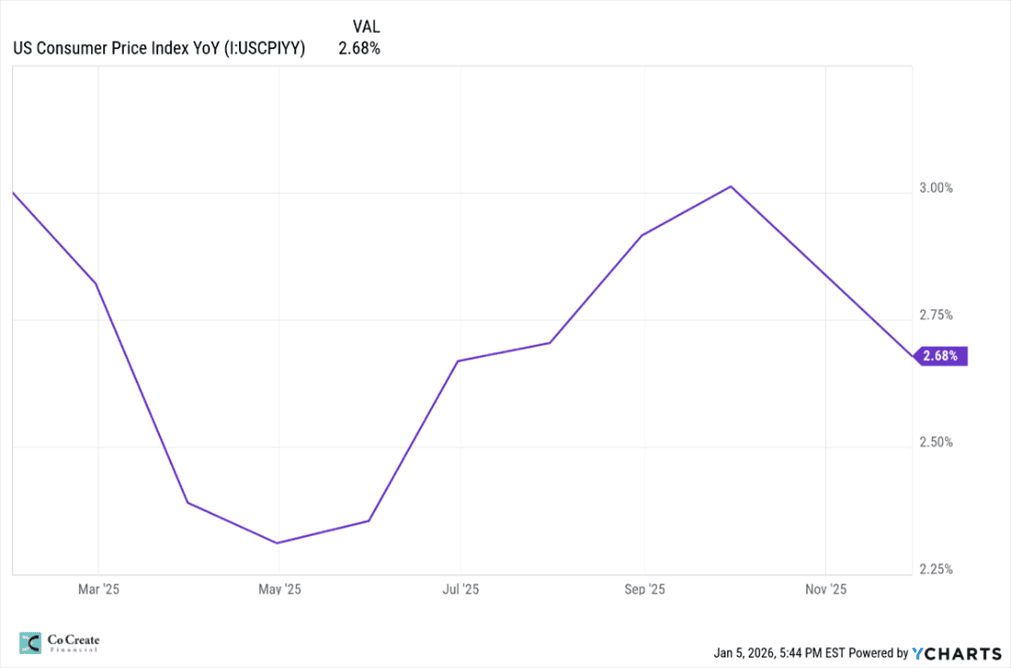
The graph above tracks CPI inflation over the course of the year. The line moving down means inflation is slowing, while the line moving up means inflation is picking back up. This back-and-forth pattern we can see explains why inflation continued to feel frustratingly “sticky,” even when some areas of the economy improved.
But the uneven path of inflation in 2025 is not a complete surprise, inflation rarely dissipates quickly, and expecting a smooth decline is not totally realistic. It’s normal for progress to stall or even reverse temporarily, especially when wages and housing costs remain elevated.
For investors, this backs up the importance of remaining patient and not overreacting to shorter-term data. The stabilization process is complex, made up of many various interlocking elements that move at different paces.
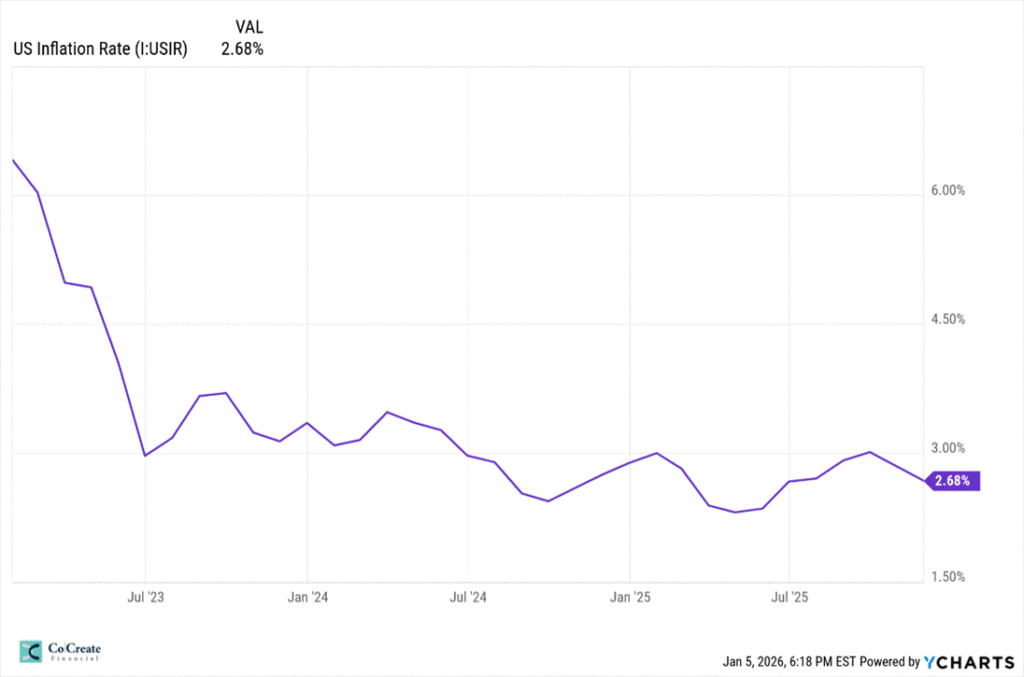
This graph depicts the U.S. inflation rate over the past three years. The broader trend still points towards gradual improvement, and we can navigate the uncertainty by remaining diversified, focusing on fundamentals, and avoiding emotional decisions based on fleeting headlines.
Throughout 2025, central banks, led by the Federal Reserve, took a cautious approach to interest rate decisions. After raising interest rates aggressively in prior years to fight inflation, policymakers shifted towards a slower, more thoughtful strategy.
Interest rates deal with the cost of borrowing money. When rates go up, loans become more expensive and spending tends to slow. When rates go down, loans become cheaper and spending increases. One of the Federal Reserve’s duties is to adjust rates to help keep inflation under control while also supporting economic growth.
Since inflation moved up and down during the year, expectations surrounding possible rate cuts were inconsistent. At times, investors expected rates to fall sooner, but when inflation readings came in higher, the Fed signaled it was willing to wait to make a move until they had a more complete picture.
Federal Reserve Chair Jerome Powell repeatedly emphasized that decisions would depend on clear progress in the data, not on what markets hoped would happen. The Fed needed tangible proof that inflation was improving.
On December 10, the Fed lowered interest rates by 25 basis points, which equals 0.25%. This was the third rate cut of the year. These small cuts suggest growing confidence that inflation is moving in the right direction, but again, these things take time and rate cuts do not bring change overnight.
Even as inflation started to cool, borrowing money remained expensive throughout much of 2025. Mortgage rates remained high, adding to the slower activity in the housing market and affecting affordability for buyers and refinancers. Higher monthly payments made homes less affordable, and fewer people chose to refinance their existing mortgages. This kept many buyers on the sidelines and reduced overall housing demand.
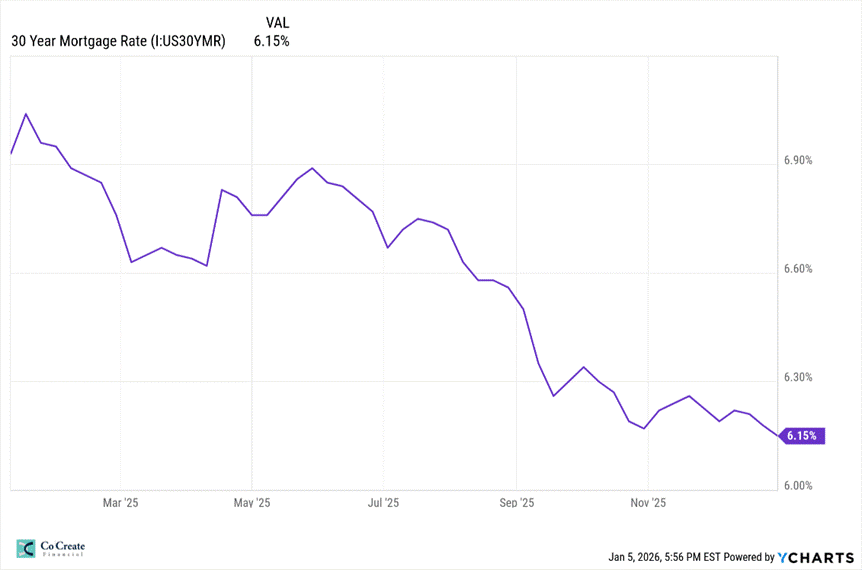
The chart above tracks the 30-year fixed mortgage rate, which is the most common home loan in the U.S. The line shows how mortgage rates moved throughout the year. When the line goes down, borrowing becomes slightly cheaper. When it stays high, monthly payments remain a challenge for buyers.
Although mortgage rates declined some towards the end of the year, they remained well above the low levels we’ve seen in other years, finishing around 6.15%. While this drop offered some relief, rates were still high enough to limit affordability for many households.
Higher interest rates also affected businesses. Companies faced higher financing costs, which made them more cautious about expanding, hiring, and investing in new projects. For consumers, borrowing became more expensive across credit cards, auto loans, and personal loans, making everyday purchases harder to finance and encouraging households to be more selective with spending.
Mortgage rates will take longer to come down, even if the Federal Reserve continues to cut interest rates. While rate cuts help lower short-term borrowing costs, mortgage rates are influenced by more than just Fed policy. Meaningful relief for homebuyers will require steady improvement in inflation and economic stability over time.
Interest rate movements had a broad impact on markets in 2025. Bond prices moved as rate expectations shifted. When interest rates stay high, existing bonds lose value, but new bonds offer higher yields, meaning better income potential going forward.
Stocks also experienced periods of volatility throughout the year. Higher interest rates make borrowing more expensive for companies and reduce the value of their future earnings, which can put pressure on stock prices. As investors adjusted to these conditions, markets reacted more sharply to economic data and rate expectations.
Despite short term swings, the higher-rate environment reinforced the importance of diversification. Balanced portfolios tended to perform more steadily, as income-generating assets played a larger role and helped offset equity volatility.
Economic growth in 2025 was more resilient than many early forecasts suggested. While higher interest rates were expected to significantly slow down activity, overall GDP growth remained positive, though more moderate than in prior years. GDP is a simple way to measure the health of the economy. It represents the total value of all goods and services produced in a country over a certain period. On the one hand, the U.S. economy continued to expand at a steady pace rather than experiencing any sharp contractions, showing its ability to adapt to tighter financial conditions. On the other hand, AI investment was responsible for approximately 92% of GDP growth in 2025 and tariffs appear to be costing about 1% of GDP.
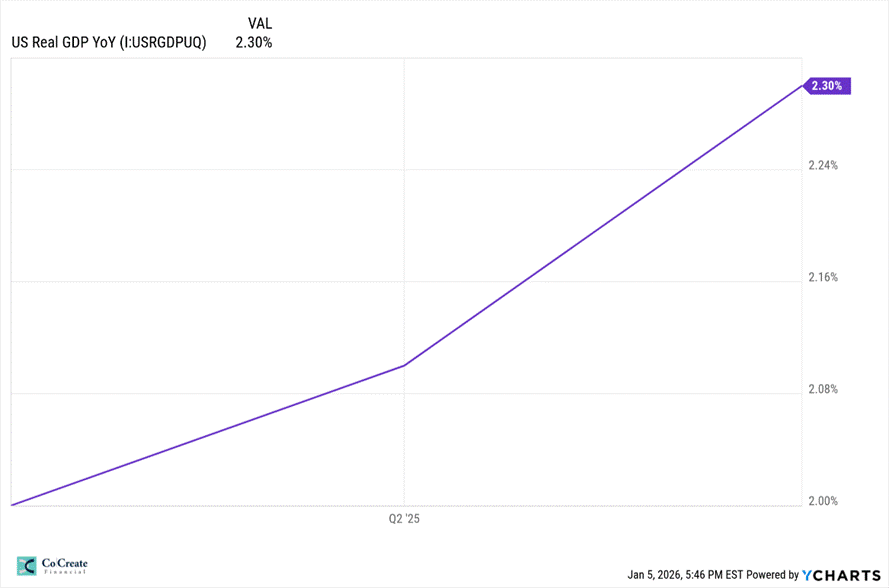
As we can see in the graph above, which measures U.S. GDP throughout 2025, the slower pace of growth suggests the economy is settling into a healthier balance. Instead of growing too fast or slowing down too much, businesses and consumers adjusted their spending and investment decisions at a more sustainable pace.
The job market remained relatively stable throughout the year, though hiring slowed compared to the rapid pace seen in recent years. According to the Bureau of Labor Statistics (BLS), total employment continued to grow, particularly in areas like health care and service-related jobs. The unemployment rate, which measures the number of people actively looking for work but unable to find it, edged slightly higher but remained near normal historical levels. This leads to a cooling job market rather than a major slowdown. As I’ve mentioned before, employers just became more selective with hiring as interest rates stayed high and economic growth softened. One notable change was a 9.2% decline in federal government employment, as hiring slowed and some government roles were reduced. This contributed to the overall deceleration of job growth.
Consumer spending in 2025 remained stronger than expected, despite the higher interest rates and prices that continued to impact people’s budgets. Solid employment and steady wage growth allowed many households to keep spending, especially on everyday needs, which helped support overall economic growth. However, when it came to discretionary purchases, consumers were much more cautious.
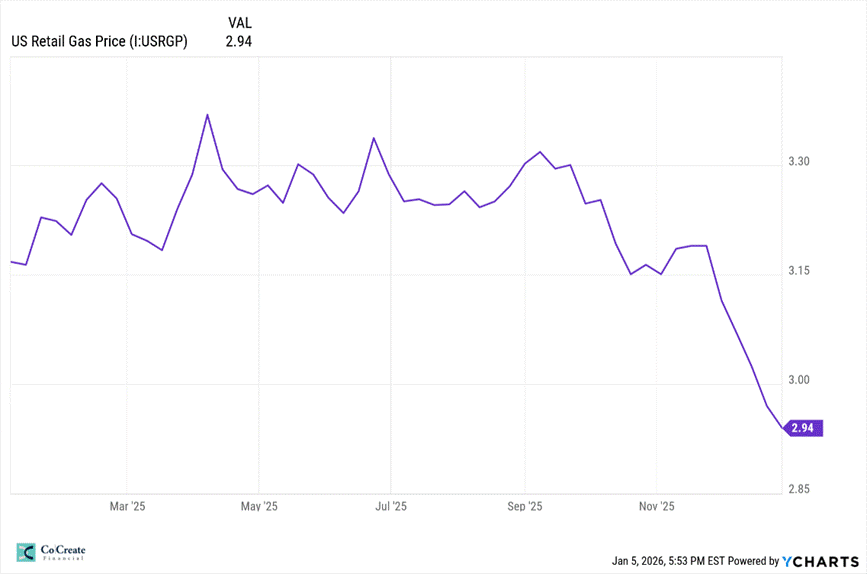
This U.S. Retail Gas Price graph highlights a positive for consumers, and a possible factor as to why people were able to keep spending. Gas prices fluctuated during the year but declined towards the end of 2025, finishing just under $3 per gallon. These lower gas prices could have helped free up budgets and allow for more spending elsewhere.
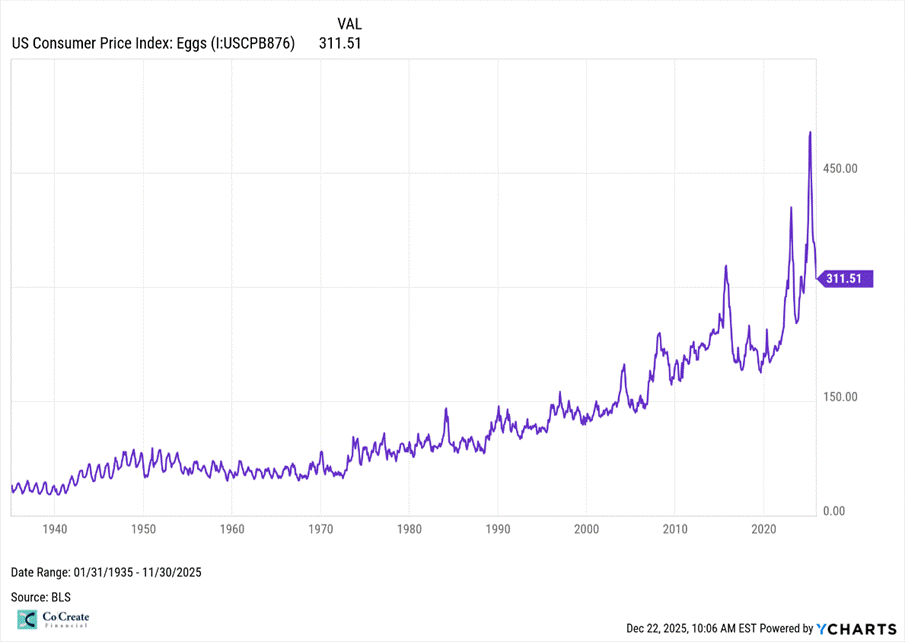
However, this long-term chart tracking egg prices tells a different story. While prices naturally rise over time due to inflation, the sharp increases in recent years stand out compared to historical trends. Eggs are a basic household staple, so rising prices here highlight how higher everyday costs have become more noticeable for consumers (if you’re spending $311 on eggs, you must be buying the Costco-size package).
Consumer spending in 2025 was less about excess and more about adaptation, which we’ve seen is a common theme in the overall market. Instead of cutting spending dramatically and abruptly, people adjusted how and where they spent their money. Lower fuel prices helped offset higher costs elsewhere but persistent increases in everyday items, like groceries, kept consumers cautious. From the start of the year, people felt a lot of hesitation as the economy sent mixed signals and pulled sentiment in different directions. Despite the concerns, the economy proved to be more resilient than many initially had expected.
2025 was a year of adjustment and adaptation. Market reactions were shaped by big policy shifts, political headlines, and changing expectations surrounding inflation and interest rates. While there were times of volatility, investors spent much of the year dealing with uncertainty and navigating the complex economic environment. Several key events and themes stood out and played a vital role in shaping market behavior.
In early April, on a day coined “Liberation Day”, the President announced broad tariffs on imported goods. The announcement triggered sharp and immediate market reactions, stocks fell quickly as investors tried to assess the potential impacts on inflation, global trade, and corporate profits.
As the year progressed, markets stabilized as people received more clarity about how the tariffs would be implemented and which industries would be most affected. While uncertainty remained during periods of negotiation, the initial shock faded as expectations adjusted.
Ongoing global trade tensions and the influx of new tariff policies added another layer of unpredictability. Rising trade barriers and high-profile negotiations influenced expectations for economic growth and international investment.
At times, discussions about scaling back harsher policies helped restore market sentiment, but renewed tensions would harm confidence once again. The shifting dynamics made long-term planning more difficult for businesses and investors.
Inflation continued to cool compared to prior years, but pricing pressures remained a central concern for investors, policymakers, and the everyday American. Even as progress was made, inflation did not drop quickly or smoothly.
Market reactions were often influenced more by headlines and policy signals than by long-term fundamentals, however this is not surprising nor rare. Short-term swings are natural, but the constant changes in policies emphasized the influence of these swings.
The rapid rise of artificial intelligence became a defining theme of 2025. Companies connected to AI saw massive increases in valuation as investors rushed to gain exposure to next “best” thing. Much of the AI investment came from the AI industry itself. We’ve discussed AI in previous articles and will be continuing to unpack the risks and opportunities.
But concerns about an “AI bubble” emerged, as people began to grow wary of the super high stock prices that did not seem to be in line with AI companies’ financial situation, leading to even more volatility within the industry. Moreover, there is an abundance of evidence that those implementing AI are NOT yet seeing a return on their investment.[1] We have been careful to limit our exposure to the risks of the AI industry throughout the year.
Fiscal policy remained a key theme in 2025, including changes to tax policy and ongoing debates over government spending.
New legislation extended and modified tax provisions for businesses and individuals, but the effects of “The One, Big, Beautiful Bill” were uneven across industries, with some sectors benefiting more than others.
The 43-day government shutdown that began in October 2025 and finally ended mid-November added to the ambiguity. While the shutdown was resolved, it brought even more short-term volatility and disrupted government services and personnel.
[1] https://mlq.ai/media/quarterly_decks/v0.1_State_of_AI_in_Business_2025_Report.pdf;
CFO Outlook for 2026: Tariffs, Hiring, Prices, and AI Impact | Richmond Fed
2025.08.27 Podcast Episode 1
Christa: Welcome everyone. We're excited for you to join us for our very first podcast for Co-Create Financial. I'm Christa.
Matt: I'm Matt,
Christa: and we're excited to talk to you about a couple of things. First, we're gonna cover just some general things that we see in the market right now, how we're approaching our client portfolios, and then we'll also talk about some firm updates and general things we have going on here at Co-Create Financial.
Matt: Awesome. I wanted to jump in here, and talk about a couple of things before the AI section where we're looking at some more, more broad issues that, you might see in the headlines, you might see in the news. And then we'll dive into the kind of the big topic that's the interesting one certainly one for us, as investors and just as human beings.
Christa: It's a question on everybody's mind lately, what's going on with AI? How are you implementing it? What does it look like and what's it changing?
Matt: I mean, one of the most fun things you can do is get on YouTube and watch videos of people trying to stump AI. Uh, it's, it's pretty phenomenal. If you do that, it's a good laugh.
With that, the first thing that I want to talk about is inflation. And the concept of rate cuts, because this is kind of the, this is the most common thing that you're hearing about in terms of risks. So when we look at it I wanna be clear, the Federal Reserve doesn't really control the economy.
They can kind of manipulate, some pricing and some capital flows, over the short term, but they really don't control the economy. That's businesses and profits and things like that. And if a business can borrow more effectively, then they're gonna have a better profit margin maybe for a little while, or they might invest and spend some more money to get some things flowing.
But overall, interest rates don't actually control the economy or market growth over time. They just kind of put some guardrails on it and a little bit of pressure. When we look at inflation though, inflation is really caused by an increase in the amount of money that exists in the economy.
It's the number of dollars for computers or for iPads or mugs or whatever it might be, t-shirts or dress shirts, whatever it is that, that you're buying. If there are more dollars the person selling that good can charge more for it because there's just more available. So we look at that and five years ago when we went into COVID, and we've talked about this a lot, feel free to explore some of our other content that, we've put out because we've talked about this ad nauseum since COVID hit.
But when you increase the amount of money the way that we did, that's in circulation, which has never been done, nothing's ever come close. That just simply increases inflation and you can buy less with each dollar when you do that. But what we've been kind of been saying over time is that as you have this increase in money supply, the price of goods and services has to increase until they're about it at equilibrium.
And that's kind of where we are right now. There are some other factors that are continuing to drive inflation forward a little bit but overall we're at a place where that issue's really resolved itself to some extent.
Christa: Yeah it's important to realize that during the COVID shutdown, there was just huge amounts of money that were injected into the economy, and that's really what drove these inflation issues is just needing to normalize that because inflation really is a monetary phenomenon.
And just like Matt said about how many dollars are chasing the goods and services available.
Matt: That's, that's exactly right. With all of that, the other thing we see with those, the inflation is the tariff issue, which is continuing to unfold. it is questionable how much the broad-based tariffs can be implemented, um, just based on, court rulings and the way the law is written.
Certainly with China and the trade war there, there's some issues where there is the authority to impose certain tariffs in some of those. And those do increase inflation because all that gets passed on to the end consumer to some extent or another, at least in the short term while all of that plays out.
So, we're getting a lot of information about all of these things in real time, and that's a lot of really mixed information. Some of that's delayed. So there are these issues about what's really going on in the economy is there transparency, with everything that we're learning.
And it's pretty good overall.
The information is pretty clear. Most of it's available with the government shutdown, which we'll talk about in just a moment. that really is delaying some information, but there are some side avenues to getting some clarity about what's going on.
There's always a little bit of a lack of transparency and a lack of accuracy in, economic numbers until they're really studied and revised six months a year down the line with more real data. Some of that information is saying that the economy's continuing to accelerate. We do have GDP growth right now, things like that, but we also see some other issues where it says the economy's decelerating jobs are frozen, businesses aren't spending money.
We have a actually a lot more earnings misses and, in the stock market where companies aren't hitting what their profit expectations were. Mm-hmm. then we have in recent quarter. So we're seeing more and more, issues with all of those things and leads to this question of are we headed into a recession?
Mm-hmm. And we've talked about that a number of times with many of our clients. We've talked, we've kind of written some about that too. Our expectations for recession are that really that we're gonna continue in the recession that we've kind of quietly been in. I like to call it a ghost recession.
Mm-hmm. Looking at that ghost recession, you know, we've seen people struggling because the grocery budgets are increasing. We see people struggling to hire employees, because of the cost of wages and it's freezing up the labor market. We see all those things playing out, and that's really when a recession starts, is when spending starts to get tighter for people.
And so when we look at that question, we've been in it, is it gonna get worse? Is it gonna get better? That's a different question. I think that there are some reasons to be hopeful about the economy, but I also think that there are a lot of risks.
Christa: You know, one of the things that's, important to remember is that for so many of us, we think of recession as, you know, the great financial crisis of '08, and we kind of anchor to that side of it.
But the reality is most recessions are not that extreme. And so even if we're talking about being in a recessionary environment, it doesn't mean the bottom's falling out of everything like it did in '08. And I think we've seen a lot of signs of people just tightening up. And then we've also seen some divergence between higher income earners and kind of people a little bit lower end on the spectrum where there's a lot of difference in how things are hitting people.
But like Matt said, everybody feels the grocery bill and is starting to make some adjustments in their spending. There's certain things that they won't give up, but other things that they're making adjustments on, that are maybe a little bit more mild. So it's been an interesting phenomenon to watch.
Matt: Yeah. And, and I believe if, we're looking at kind of the different income, levels within, society, the top 20, was it top 25% of people that are, continuing to spend as they have been. But when we look at the bottom 75% of the income brackets, they're really compressing. They're spending, they're tight, they're feeling this.
So there are a lot of things that are kind of challenging in that front for the majority of people in our communities. Mm-hmm.
On that note, I do wanna mention with the government shutdowns. We've had a lot of government shutdowns. I don't know if you recall the number that we, that we've had.
It's escaping my mind at the moment, but we have the government shutdowns all shuts down all the time. Unfortunately it's becoming more and more common as we get more polarized and have more gridlock in Washington. But, we've never had a recession, follow a government shutdown really in close proximity at all.
So, that when we look at those government shutdowns, they don't lead to recessions. They don't lead to significant economic problems. So while we're concerned about our government's ability to get things done and our government's ability to work together, I don't think that this government shutdown is gonna drive us into a recession or an economic crisis or a catastrophe.
Certainly it affects individual lives, people working for the government, but it's not gonna cause, a significant economic issue in part because a capitalist system doesn't function on government spending. It functions on corporate profits and private business. I'm going out and making money, paying employees, people buying and selling goods.
It's not about the government telling it what to do.
Christa: Mm-hmm.
Matt: So I think that sounds really good.
Christa: Exactly. Yeah. We. You know, it's certainly concerning the government being shut down on some levels and especially as it impacts individuals, but it's not shutting down our economy and that's an important thing to remember.
So let's dive into this question on AI and what that means for investments and what we're seeing now in the current market because there has been this explosion within the stock market and anything that has anything to do with AI. So do you wanna chat some about that, Matt, and talk about how we're viewing and engaging that.
Matt: Yeah, absolutely. The AI industry, let's call 'em the hyperscalers but really this artificial and intelligence industry has driven a tremendous amount of growth, not just in these companies, but in the markets as a whole. When you look at some of these companies, you've got people that have got, 3, 4, 5, 900% returns on a singular stock. And the thing that really, it looks like the most is the .com bubble in the 1990s. When we think about that, everybody buying these, these stocks thinking, you know, this is gonna be the future. This technology's gonna change the world. and of course the internet did.
Mm-hmm. Um, but what's gonna be pets.com? And go out of business, what things are gonna survive? Even those, the companies that do survive take, I think Cisco for example, it was massive in the 1990s. Shot up in price, before the 2000 crash. And, of course, it came crashing down and Cisco's still around and it's still a great company.
But when you look at these tech companies, these NVIDIAs, these, Broadcom saw open AI, all these different tech companies that everybody's investing in, thinking this is gonna be the future. They've really shot up in a way that resembles that tech bubble. Mm-hmm. One of the things that we're hearing a lot is that, you know, this is different this time.
Christa: Yeah. A lot of people are saying that, they're saying, you know, AI is the future and things are moving so fast, and technology is being adopted so fast, so it's different. Right.
Matt: And because we're selling a service instead of just hopefully like having something turn out because of all the marketing hype.
There's a little bit of, there's some structural differences, going on, and we could get into how all the IPOs were going on in the nineties and if you really wanna talk about that, gimme a call. And I'm a little bit of a nerd, so I'd be happy to chat with you, but nobody wants to hear about that on a podcast.
Well, maybe some do, but not here.
Matt: So when we look at that, we have to, to really understand what's going on, and then how those are affecting, the overall market. So I'm gonna pull up a little illustration here, it's just a little chart on my whiteboard of the S&P500, which the S&P500 is a grouping of the 503.
My computer's not plugged in when you plug that in so you guys can see what we're talking about here. It's episode one. So when we're looking at the S&P500 it's the 503 largest companies that are traded on a US stock exchange. So these are all businesses that you can own.
And if, we're looking at this on my screen here, you can see the top companies of these. You've got Nvidia, Microsoft, Apple, Amazon, Broadcom, Meta, Alphabet and so going down, of course there are two different shares of Google, so Google shows up twice. But when we look at this, these are all grouped and ordered by size
so the S&P500 owns the most of the biggest companies.
Christa: That's why we refer to it as a cap weighted index. The companies at the top are a higher percentage of the index.
Matt: Yep. And so what is it about 40% if we were to look at, the top 10 or so companies here? I think that's gonna go down to about JP Morgan on my screen.
If somebody, you can count, you can see the whole, list of the top, 25 or so here on this screen. But this is about what, 40% of the S&P500, that's a massive amount of anybody that's in an index fund. That's a massive amount of what you own. It's a massive amount of market growth. The S&P500 is what people talk about when they say the stock market.
It's predominantly, they're talking about this right here, this grouping of 503 companies. And it's mostly these giant AI tech companies or tech companies that have AI exposure. If we go through it, apple doesn't, Amazon has some, but less than some of the others. Obviously Nvidia, Broadcom, Alphabet, all do, Tesla, doesn't have a ton, but, there's exposure, just with Grok AI and things like that through kind of by proxy with X. But Google, of course, so we're looking at these companies are really heavily influenced by AI and if you own an index fund, that's 40% of your portfolio. Yeah. This isn't how we invest, by the way. So when we're talking about this, we're talking about, a different strategy than what we're engaged in with our client portfolios.
Christa: Yeah, just emphasize that Nvidia alone is 7.5% of the S&P500. So, you might think you're diversified 'cause you're investing in 500 companies, but the top 10%, top 10 companies are 40%, which means that the remaining 60% is among those 490 companies. So, it's really quite focused on this AI space and the top companies.
Matt: So looking at those top companies then, when we're looking at this AI, well, I'm just gonna call it an AI bubble. I mean, Mark Zuckerberg's talked about a possibility there being an AI bubble. So is the CEO of Open AI. So like, I think it's fair to call this, to kind of call this what it is.
There's this bubble that's built around, the future of AI, it's around what need it might produce in the future, and to give you an idea of the size of this bubble, when we look at it right now, artificial intelligence is, producing about 50, 50 billion in revenue, that sector of the industry, and these are companies that people are paying
$125 or 125% of earnings. So $125 for every dollar of earnings. That's a lot of money. It's expensive. To give you an idea, it would take somewhere between 2 and $5 trillion of revenue coming in from these companies in order to cover that.
Christa: Justify the cost of the multiples that people are playing at
and just to back things up a little bit, when we look at stock prices and stock valuations, we say, you know, a company for it to be worth investing in and owning means that it has to pay you as an owner. It has to be producing profit. And that's what we're buying. We're buying an income stream for the company.
And sometimes there's, you know, a lot of people invest in kind of the speculative side of investing, which is saying, Hey, maybe this company doesn't make money now. Or maybe they don't make a lot of money now, but we think they will in the future. And that's what people are doing on the AI side. But the thing is, is that we have to eventually get to the point where it produces enough revenue to justify those costs, because otherwise it's just eating up all that money and that's gonna come crashing down at some point. And so that's the fundamentals of how we view investing in the stock market, is what is the cash flow and what's that gonna pay you as an owner and how are you gonna get a return on your investment?
And it's not just hopefully it goes up more. There has to be a reason it's gonna go up more and that's cash flow.
Matt: Yep. So there's this massive expansion in revenue that AI needs. We're seeing some other challenges within the AI world, let's call it. MIT just released a study, recently that reported that 95% of AI startup, or implementations pilot programs is the term,
that 95% of those fail to deliver or return on investment. So all of this adoption of artificial intelligence and companies saying we're gonna make things efficient, streamlined, we're gonna generate profit, reduce the number of jobs that we need to have, which is an entirely different side of this conversation.
But they're looking at all this information. They're saying, we're gonna make this work for us, and it's not happening. And so this revenue growth, 50 billion to five, two to 5 trillion. We're struggling to have the productivity on the front end, on the user end in order to drive that growth. That's not that it won't be there, just like the internet changed the world.
Artificial intelligence can change the world, but we have to have that start, have it start to be functional and useful. The MIT study also looked into what it was gonna do to jobs since I brought it up and it's probably not going to end up eliminating very many jobs, at least not for the foreseeable future according to that perspective.
We're also right about at peak data. Which that means that we've used all the data that it needs to train on. There's not a lot more out there and so we have this impending crisis of running out of information for AI to learn. And if you watch some of the YouTube videos about people [00:18:00] stumping AI, how many Rs are in strawberry or is 9.11 bigger than 9.9?
Things that seem like easy questions that AI can't pull together. We're running out of data for it to learn from, and it's starting to supplement that with AI produced content, which is unreliable yet. And so there's this a big issue that's kind of coming down the pike with that component of it.
Christa: So Matt, so we've kind of covered that. You know, we certainly have concerns about investing in the AI space. We recognize that it will have profound implications for the future, but we're not seeing a clear path to justifying the current prices for these companies. And we do expect the valuations on those at some point.
We don't know when. We can't know when we'll come back down to earth. How are we approaching this from within our investment philosophy and what we're doing for our clients and how are we mitigating these risks and what can people kind of look to and see in their portfolios?
Matt: Yeah, absolutely. So first thing we're doing is we're looking for the appropriate exit points. We don't have a lot of exposure to artificial intelligence directly these hyperscalers. We do have some that was coincidental because we bought them as best in class businesses before this AI trend took off.
And so some of that we've been able to ride along and we've been able to take some profits out as we go. That's a really important thing is you're making money in the stock market, is to know when to take profits. out so that you're not overexposed. But with that, we're, we're looking for, you know, what are the exit points for these companies where you have a 500% return on whatever AI stock, when do you get out and what's gonna change it?
In the 1990 to two, uh, late nineties led to the 2000 bubble coming down and really it was kind of this turning point where it was, you know, feds changed some interest rates and started kind of unraveling and it was just, there was this tipping point and we don't know what that's gonna be. So we're looking to de-risk in our portfolios from the AI exposure so that we're not dependent on this massive increase of AI data.
I have a chart on my screen here that we can share AI the orange line here is the S&P500, and the purple line is the S&P500 as well. But remember how we talked about that, the top companies being the biggest ones, and they're about 40%. Well, the purple line is if you just took them at an equal part of the S&P500, instead of having it weighted like that.
And functionally, what this does is this gives us a really good idea of the difference in pricing between AI and the rest of American businesses.
Christa: We've really seen, you know, it seems like so many things have gone up together in this AI level, but when you get into the data, if there's really been a clear divergence between companies in this tech AI space and companies that are just doing other business and good business.
And so that's one of the things that we're watching is that divergence in the space.
Matt: Yep. So our portfolios and the investments that we hold much more closely reflect the S&P500 equal weight index than they do the S&P500, in part because we have investments that are balanced appropriately and diversified in an appropriate mix versus being concentrated and AI or any other given or necessary specific industry.
The other thing that we're looking at is, just having consistent and steady cash flow coming in, and not relying on future promises of revenue that aren't gonna come. I mean that all these AI companies are relying on, you know. Hundred, $500 billion investments from one another. And they're dependent on all of these.
And it's kind of the circular mix of capital that they need in order to survive. And products that they wanna buy from other companies that are needing their own investment. And this big kind of circular problem. In fact, I think I have a quote somewhere in our notes about that. I don't know
If that's in here, but it's pretty great. This was from a JP Morgan, research analyst. It says, Oracle stock jumps by 25% after being promised $60 billion a year from Open AI. An amount of money that open AI doesn't earn yet to provide cloud computing facilities that Oracle hasn't built yet.
And which require 4.5 gigawatts of power, the equivalent of 2.25 Hoover dams or four nuclear power plants, as well as increased borrowing by Oracle whose debt to equity ratios already 500% compared to 50% for Amazon or 30% for Microsoft, and even less at Meta and Google. In other words, the tech capital cycle may be about to change.
Christa: So we've seen a lot of excitement around how these companies are investing in each other. But none of it's come to fruition yet, and we're very concerned about that.
Matt: Yep. So what we do in our portfolios then is we own these dividend yielding companies. Predominantly we're looking at companies that have free cash flow.
We're looking at companies that have a profit margin, that have a product that people are buying. That is something that's different than the AI industry in this AI cycle, and it doesn't look as exciting. It's not as fun to, to kind of do the slow and steady, especially when things are taking off in a bubble like this.
But we're really trying to go to the tried and true the things that are gonna give you a good long-term return, a rising stream of income from dividends where that's safe and secure. I mean, there, there are always risks that exists in the market and in business ownership. So something could happen to one of these, but we diversify our portfolios and measure that
so that we're making sure that we're not too exposed to anything in particular that's gonna cause our clients to have a lapse in cash flow or any kind of long-term issue with growth kind of going forward. So we're expecting that to be a much more responsible, tried and true way to get a good return over
the long haul and asking when do we get out of the things that have this excess risk.
Christa: Yeah. Absolutely. So, kind of to recap there, it's just important to remember as you hear the bad talk around AI there are concerns there. There are major risks, and we are actively mitigating those in our client portfolios and making sure that our clients are set up for success on the long haul with tried and true research backed methods, not chasing the next hot stock.
So you don't have to be afraid that you have this exposure that the S&P500 does. We've already mitigated that and are constantly working on that in our portfolios.
Matt: Yeah, we do believe that there's growth opportunity out there and that there's a way to, make money in our stock markets and our other financial capital markets.
So this isn't a, we should pull the rip cord and get out. We need to be very strategic and very careful about how we measure risk and reward in our portfolios as we manage those on a company by company basis. And we do that and measure that every month by the way, we get together and sit down as a team and review every holding that we have and make sure that,
all of the financials look good and that everything is squared away and we're confident in its ability to continue to perform like we need it to for our clients.
Before we talk about the last topic that I think is a really significant concern right now in our economy, in our markets, I just kind of wanted to talk about a couple of the things that we have going on around our firm.
We've been doing a lot of work. Yeah. Over the last year.
Christa: Yeah. We've been doing a lot of building out infrastructure within our firm and some exciting things that are coming up.
Matt: Yeah, our goal is always to make a really great experience for you as the end client and being a small business, we have the ability to adapt and do a lot of fun things.
The first thing that,I wanna talk about is kind of my passion project, and maybe you can talk about, the addition of Altruist just a little bit after that. We have added the ability to vote client proxies. Which I'll tell you what that means. Okay. Because there's gonna be a new agreement that we're gonna start working into our client conversations and talking about with individually as we sit down with each of you.
But investments can change the world. The stock market is actually a democracy. Everybody likes to complain about corporate America and what it's doing in our world, but we actually have the ability as business owners of these companies to have a voice and you get a vote and there are all kinds of things that show up on these ballots that come from the owners of a stock that are really significant.
A recent one that comes to mind was related to Facebook and children getting access to pornography. Some of these might be about environmental stewardship. Some of these might be about a lot of other different topics that people are passionate about and that you think are important.
What people don't realize is that most of the time you're giving your vote, especially if you own a fund and you don't work with us, where we own the investments directly, you're giving your vote to somebody else and most of the time you're probably not gonna agree with them.
Christa: Yeah. So if you own a mutual fund or an ETF, if you're in those vehicles, that fund manager gets to vote your shares.
Matt: Yeah. So to talk about this Facebook example, about 95% of the votes that went in aligned with management and said that we're not gonna do any investigating or work on this issue that pertains to children receiving access to pornography. And it was somebody who owned Meta stock that brought that to their attention.
And you don't have to even own a lot to do that. Well, one of the things that we've done is we've gotten set up so that we can actually engage with you so that you can authorize us to go through those ballots that you receive in the mail and say, this looks like junk mail. And you check it. Those are actually really important to you.
If you want to, we can vote that for you and help give voice to things that really matter. Things that are important that can direct, kind of the future of our society and help set culture here, right here in our country and our community. o we're really, really excited about that.
Christa: Yeah. So we'll be talking more with our clients about how we started that process and roll that out over time here.
The other update we wanna share with you is currently we've been in this situation where we custody all our client accounts at Charles Schwab and we are going to continue to contract with Charles Schwab and custody client accounts at Charles Schwab.
However, we have also onboarded an additional custodian to enhance our client experience. Many of our clients have a great experience at Charles Schwab, but some of them, it can be a little clunky. And so we have onboarded with a firm called Altruist that offers a more tech forward streamlined experience that I think for some of our clients is going to be a better fit and a better experience than what they're currently receiving on Charles Schwab.
There are some nuances as to what types of accounts are a better fit for one or the other. So this is not a blanket sweep. If you're happy with Charles Schwab, we're happy to keep you there, but if for some reason there's some challenges with just how you're feeling about the paperwork processes or updates to your accounts, it might be a good time for us to transition you to our other custodian Altruist because we're excited about what that'll mean for the future.
Or junk
Matt: mail or junk mail,
Christa: less junk
Matt: mail,
Christa: and it'll just be a more streamlined experience for our clients.
Matt: Yeah, we're really excited about that. It's just gonna help us optimize even more. And of course, if you're on one or the other, it's always gonna be available through your co-create login or on our app.
So you can access all of your information and data there at any time.
So the last thing on the agenda is to talk about the final piece. And I think this is one of the bigger risks over the long term to our economy. Kind of even more than the AI bubble that's gonna come back down to Earth and probably skyrocket again and come back down to earth in this up and down cycle.
But I think one of the biggest risks that we actually see, right now that I just wanna bring attention to is what I would call the degradation of the free markets. We're seeing a lot of government influence, and this is not just this current administration, it's also the previous one and the one before that this has been going on for a while.
And so when the government gets involved in business it slows growth, it creates bureaucracy. That's not to say that we don't need any regulation, or any government involvement whatsoever, but it's saying we need to balance that very carefully and very appropriately. And one of the things that we're seeing is, a shift in how the government and gets engaged with business and owning golden shares of, say, Intel or negotiating for ownership stakes in these businesses.
The Communist Party in China actually owns golden shares in every business that's Chinese. So when we talk about owning golden shares or government owning business, we're actually socializing a lot of the free market economy that we have. Whether that's good or bad. We will find out someday.
We don't know, but it is a fundamental shift in the way that our capital markets work and the way that our government systems and our investing strategies can integrate it. And so it's something that we're gonna be paying attention to over the next decade. I'm very carefully is how the government's inter engaging in the capital markets
because it has a significant impact on the long-term performance. I mean, for better or worse.
Christa: Thank you for joining us for our very first podcast. We appreciate all of you and please feel free to reach out with any questions if anything you wanna chat about more and we look forward to sharing with you again soon.
In light of recent tariff and geopolitical events, we’ve decided to begin publishing a short piece every Monday to discuss what we think we will be doing to navigate the recent crash and eventual recovery. We have a history of being both supportive and critical of any politician or perspective, so the commentary below not intended to be a comprehensive statement or endorsement any politician, candidate or platform. Please be aware that we will need to avoid publishing certain details for compliance purposes but are happy to discuss any of the comments with you in the specific context of your account.
We manage the account on your behalf. That means that we are making adjustments, increasing/decreasing cash and cash investments, making portfolio decisions and carrying the stress of market turmoil on your behalf. We love to hear from you about your needs (and feedback), but please don’t feel the burden of managing your portfolio. Obviously, this note is for clients of CoCreate; if you’re not a client of our firm, consider reaching out to see if we can help you enhance the way your accounts are performing in this environment.
Also, publishing about the week ahead is a difficult task and some or all of the things we say may change or play out completely differently than we expect. Regardless of short-term market fluctuations, we will remain disciplined and committed to following our time-tested approach.
Yes and No. On April 8, the President paused the “reciprocal” tariffs. These “reciprocal” tariffs weren’t related to tariffs imposed upon the U.S., but were based on the difference between imports and exports with each country.
The 10% broad-based tariff is in place. This is effectively a back-door sales tax on U.S. consumers (about $1300/year for every household according to the Tax Foundation). I’ve heard a number of news broadcasters express wrong information about whether or not the tariffs are in place. This is part of the Trump negotiating strategy, to create enough chaos and confusion that it is difficult for those he is negotiating with to fully understand what is happening. In is role as President, this has an affect upon the public’s understanding as well.
First Trust Economics: No America Didn't Stop Making Things
For anyone casually watching the stock market, the past two weeks have actually looked relatively good. The last eight days showed positive returns for the S&P 500, and if there weren’t significant outstanding issues, it would look like the markets might rebound. We’ve been watching the $5800 price point on the S&P 500 as a potential turning point. All the charts and graph wizardry that investors are known for has no reason to work, but sometimes it does. Right now, we’re sitting at a place where the market could go either direction. Andrew Adams from Saut Strategy put it this way:
Yet at the same time, the stock market has so far done everything that it's been asked to do since marking its lows in early April. Several resistance levels have been overcome, breadth has recovered to neutral from its washed-out lows, and the S&P 500 has now traded well into that 5500-5800 region that always felt like a logical target zone. Buying has indeed been strong. I wrote last Wednesday that breadth had been good but not as outstanding as it appeared, yet Friday's session was almost a 90% upside day and helped to improve those total breadth readings. The move off the low is certainly very reminiscent of others we've witnessed over the past few years that began larger rallies. It wouldn't exactly be shocking to see the market shake off the recent weakness, especially if all these trade deals they are supposedly working on start to get announced soon to keep waving a carrot in front of buyers.
However, it can also be argued that the real test for the stock market is only now beginning. The S&P just entered on Friday what has been a major "pivot" point over the past 10 or so months. As the chart below shows, this region has been the site of both support and resistance in that time and is a primary reason why I've used ~5800 as a key area to watch. It's also why I've said that if stocks are going to roll back over, it is likely to happen around or below this zone where heavier resistance is found. Clearing that region will be a big win for the bull case and increase the odds further that a major bottom has been made.
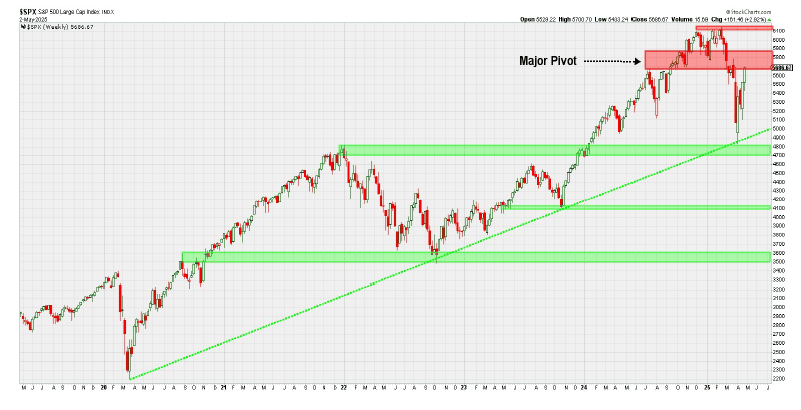
Right now, we’re sitting at a point where the market could go either direction… except that there are significant topics that still need to play out and the positive growth ignored what should have been headwinds. First, many corporations announced their first quarter results. Some of them adjusted their forward looking projections to account for the potential impact of tariffs, some chose more of a wait-and-see approach remaining optimistic. It was interesting to watch, and while I’ve not measured any data to confirm this, it certainly felt like those companies who chose to be realistic about the threat had share-price declines and those who did not had price increases. If that’s the case, it should bode well for us this month to rebalance our holdings because that is the opposite of what I would want to see.
Of course, the first quarter’s results don’t include the tariffs, and included quite a bit of noise from the business trying to buy ahead of the tariffs. This boosted earnings significantly. The Second Quarter results, will begin to show the damage. For companies who are riding high on Q1 optimism, Q2 will be a big adjustment.
While the future of tariffs is still very much unknown, we’ve been working hard to prepare portfolios in as many ways as possible. We are looking at the probability and potential return versus risk of loss and we’ve even implemented Artificial Intelligence (AI) tools to mine for information that could specifically impact each investment’s sensitivity to tariffs (this would include company filings and exposure to various countries). This is our first foray into using AI for anything more serious than the photo for the weekly playbook series.
Q1 Real GDP came in at -0.3% (annualized), with business and consumer spending heavily enough (presumably to purchase ahead of tariffs) to increase Core Real GDP at 3%, which is the same as Q1 last year. Real GDP is regular GDP adjusted for inflation, Core Real GDP is consumer spending, business fixed investment, and home building, and excludes the most volatile categories like government purchases, inventories, and international trade. While it is difficult to estimate accurately, tariff frontrunning may have boosted Q1 GDP by as much as 2%. This won’t be part of Q2 GDP. The technical definition of a recession is complex, but most people use two consecutive quarters of contracting GDP as shorthand. I believe we have actually been in a recession since mid-2024 when people were out of COVID-19 money and began to really feel the impact of inflation. This means that we’re now seeing that reflected in GDP (among all the other things).
It’s important to remember that looking back on Q1 or the past week is just that, looking back. In some ways it is helpful to understand the investment and business landscape, but the role of an investor is to look forward with optimism for the long-term future.
While we look forward to the long-term future, I’ll once again quote Andrew Adams:
As impressive as the rally has been, it is also still within the limits of historical bear market rallies. This inconvenient truth is why simply assuming it's straight up from here remains a risky proposition. In 2000-2003, for example, the S&P 500 lost 50% overall but there were six separate rallies of 10% or more during that time, including three of more than 20%. In 2007-2009, the S&P fell 57% but there were four rallies of 10% or more, including two greater than 20% (this is yet another reason why I think it's silly to use 20% moves to mark bull and bear markets, but I digress). So even though this rally from the lows has been strong, it wouldn't be historically atypical for it to still roll back over.
While I genuinely hope the market losses and volatility have turned around, there isn’t quite enough evidence for me to fully commit to the paradigm at this point. We will still need to focus on collecting rising dividends from strong companies who are as insulated as possible from trade risks and balance the risks with appropriate levels of cash.
This week we will continue to watch for trade negotiations. I have yet to hear any actionable news other than that of a rare earth minerals deal with Ukraine. Canada’s new prime minister will meet with Trump on Tuesday and has expressed a willingness to be both demanding and patient.
The Federal Reserve will meet this week. We are not expecting a reduction in interest rates, and I believe this is good. On the one hand, a rate cut would stimulate capital investment a little and soften the blow of tariff price increases, It would simultaneously have the opposite affect because increased money in the system increases inflation. Managing the stock market is not part of the Fed’s duties, so they should opt to protect the purchasing power of the dollar. Powell’s position also puts pressure on the Administration to bring its tariff negotiations to a head quickly so that it is far in the past when we get to the mid-term elections.
On the policy front, we are continuing to watch for a tax bill and additional deregulation. Musk reported that DOGE eliminated at least $160 billion in spending, and though he is stepping down, the administration will continue to hold this as a priority. Aside from the spending itself, excessive and nonsense regulation has been the biggest headwind to economic growth for quite some time. The combination of the reversal of the Chevron Doctrine last year (The Chevron Doctrine established that Federal agencies could essentially replace Congress in rule-making) and efforts to reduce burdensome regulations is the only thing that has the potential to offset tariff risks.
Republicans are still working out what may or may not be in a tax bill, and there are quite a few different opinions. Here are a few key topics in debate:
The issues in discussion will demand compromise because there are not enough productivity-boosting components of the bill to allow Republicans to use the budget reconciliation process and include all their tax cuts. Essentially, they won’t be able to offset the proposed tax cuts with enough future revenue to pass a bill that includes all of it with just a simple majority in the Senate. Tariffs won’t make up this lost revenue either, which was undoubtedly one of the initial hopes of the Administration. We’ll be watching to see what happens here, as the house has set a goal of getting this through by Memorial Day weekend.
Any good news, or even just clarity on any of these fronts should be a positive for financial markets and for our client accounts. Expect markets to continue to fluctuate in the meantime with a reasonable likelihood of declining more before this is finished. When it is all said and done, American businesses will continue to have competitive advantages and will prosper. We’ll continue to own what we believe are the best of them.
I hope you have found this insightful. We will continue to publish the Weekly Playbook as long as it makes sense to do it. In order to keep from spamming you, we may not always send it by email, but will certainly post it on our website at https://cocreatefinancial.com/ and in your client portal’s newsfeed. We double down on commitment to stewarding your investments and financial plans with diligence and integrity when the economy and markets are turbulent. Thank you to all of you who have trusted us to do so on your behalf.
In light of recent tariff and geopolitical events, we’ve decided to begin publishing a short piece every Monday to discuss what we think we will be doing to navigate the recent crash and eventual recovery. We have a history of being both supportive and critical of any politician or perspective, so the commentary below not intended to be a comprehensive statement or endorsement any politician, candidate or platform. Please be aware that we will need to avoid publishing certain details for compliance purposes but are happy to discuss any of the comments with you in the specific context of your account.
We manage the account on your behalf. That means that we are making adjustments, increasing/decreasing cash and cash investments, making portfolio decisions and carrying the stress of market turmoil on your behalf. We love to hear from you about your needs (and feedback), but please don’t feel the burden of managing your portfolio. Obviously, this note is for clients of CoCreate, if you’re not a client of our firm consider reaching out to see if we can help you enhance the way your accounts are performing in this environment.
Also, publishing about the week ahead is a difficult task and some or all of the things we say may change or play out completely differently than we expect. Regardless of short-term market fluctuations, we will remain disciplined and committed to following our time-tested approach.
This depends on your particular situation and a variety of factors:
What’s going on presently is, unfortunately, real. Often, our response to various events and headlines is that they are just “noise.” The issue with tariffs is that they will actually affect business profits, consumer purchasing power, and supply chains once they are implemented. These aren’t transitory phenomena. They will effect portfolio values negatively and then growth will resume. The question on both sides is: how much? The markets may have already accounted for the potential issues or they may have additional declines in the process.
Our long-term forward projections are called Capital Market Assumptions. These “CMAs” are how we estimate long-term returns. When Covid hit, we expected to see slower growth for a number of years to come because the stimulus packages were inflationary and (as stimulus always does) borrowed from future growth to enhance the present situation. The Covid economic recovery is actually still playing out and is likely still in its adolescent stages. The trade-shifts and tariffs will be another adaptation to these Capital Market Assumptions.
We have begun updating our client’s financial plans and hope to connect in detail with everyone this year for a more comprehensive update than usual. With the updated information, we’ll be able to apply changes to our long-term projections and get a good idea of how they will affect each of our clients. The good news is that unless we’ve already been telling you your withdrawals may not be sustainable, we’ve designed your plan-portfolio pairing to accommodate for situations like these. Also, by being on the front-end of the situation, small adjustments to a financial plan can lead to significant improvement over time. IF one of your goals does appear to be at risk, it can likely be addressed with a small, manageable adjustment if we don’t wait until it becomes a crisis.
Last week was relatively un-eventful compared to the previous weeks, giving us the breathing room to do much of our normal investment management work. Last weeks economic/political events included the beginnings of “productive” (“?”) trade negotiations with a number of other countries and escalation of problems with China. China’s actions included ban on a number of US imports (including the return of Boeing 737 deliveries), as well as a ban on the export of rare-earth minerals to all other countries. “rare earth minerals include everything from magnets to lithium for batteries to Uranium. China produces 60% of the world’s supply of these minerals so the ban will have a meaningful impact on global supply chains. Much of the process of bringing industry back to the US, or establishing it in a different location will take many years. Much of China’s Xi Jinping’s top priority will likely be preserving the dominance of the current political regime in China despite the intense recession they have been experiencing. Xi Jinping’s visits around Southeast Asia didn’t appear to be as fruitful as he would have hoped, hence the complete ban on rare-earth minerals (an attempt to block reallocation of supply among different trading partners such as Vietnam). We can assume that this response is positive for US negotiations as we remain the preferred destination for exports.
The other noteworthy event was Federal Reserve chair Jerome Powell made a statement that declared there would be significant “uncertainty” from the tariff policies and lack of clarity in the rollout. His statement announced that they would not be lowering interest rates until there was more certainty about what these would look like going forward. President Trump, who is not a fan of his appointee, Powell, took issue with the statement. The Economists we follow are mixed in their sentiment about this move, and several say that Powell’s Fed will have no option but to lower rates in June based on their dual mandate to manage stable currency value and low/reasonable unemployment. We haven’t been crazy about Powell around our office, particularly because the Fed didn’t really even try to mitigate the Covid-stimulus-caused inflation until it was far too late. Mostly it was because they either didn’t understand that inflation is excessive money-supply (both Democrat and Republican caused), or because they were simply dishonest with themselves and the public about their own power to manipulate the economy. That being said, I believe this was the right move for Powell. He is being cautious and cognizant of the inflationary effect of tariffs. It also applies pressure on the Administration and we are firm believers in checks and balances within government are a good thing.
Our week consisted of our monthly deep dive into the investments we own in client accounts. We can’t get too specific in a newsletter for legal/compliance reasons that would limit our ability to be flexible and adaptable in client accounts, but overall, we are quite happy with the mix of investments. We look at and discuss a number of factors in this process including price action, financials (earnings, profit, assets, etc.), changes in management and product demand, and review what a variety of research analyst are saying. We also rotate through various processes on a quarterly basis. This month we pulled a report card to measure our diversification using the “correlation coefficient” of each investment. The correlation coefficient is essentially how frequently one investment moves in the same direction as another. Our conversations also focused on potential outcomes from tariff policies. Because we engage with these investments regularly and look for weaknesses or risks, the investments in our clients accounts have been very healthy going into this season and their financials and dividends remain strong. If any of you would actually like to speak in detail about this process and your portfolio, we’re more than happy to talk through it.
I’m really grateful for the feedback from all of you who are reading this. I had been considering how long to continue a weekly market update, but since a number of you are finding this helpful, we’ll continue to do it for longer. The caveat, I would ask each of you reading this to be careful not to follow the markets too closely. It’s potentially a very dangerous activity for those of us who are long-term investors because we generally will want to move one way or the other when what we need to do is simply stand our ground. I would much rather have you ignore these emails than take that risk, so please know yourself and send these straight to your trash bin if they make you more nervous or tempt you to be overly tuned in. You pay us to carry the day-to-day burden of managing your investments for you and we’re completely ok if you want to tune-out until things turn around. (if you’re a client, please don’t unsubscribe because you’ll miss important logistical emails if you do. Just reply to this email and I’ll take you off this particular list)
This week, we’ll be continuing to watch for policy developments and to watch corporate earnings announcements. On the policy front, I expect that it will remain nearly impossible to determine what will happen next until whatever it is takes its final form. If you read Trump’s book The Art of Negotiation, his first step is to create an extreme demand, the second is to create confusion by establishing many different and complex negotiating points while rapidly shifting from one to the next. It seems that we are in this stage with international trade policy. We will continue to watch this develop and respond in real time while exercising appropriate levels of patience and diligence.
We expect Corporate earnings to be a misdirect. The first Quarter earnings won’t account for much of the trade issues we are experiencing because they were announced on April 2. We believe that markets will take some comfort in reasonably strong earnings results. We also expect significant adjustments to forward expectations as companies announce their assessment of the economic situation. Most companies have prepared at least rudimentary plans to adapt and will probably announce much more detail on their earnings calls. We expect markets to overreact to these announcements, possibly in both directions depending on whether the announcement is better or worse than consensus expectations. When this happens, the right thing will be to wait to react until the dust settles.
I hope you have found this insightful. We will continue to publish the Weekly Playbook as long as it makes sense to do it. In order to keep from spamming you, we may not always send it by email, but will certainly post it on our website at https://cocreatefinancial.com/ and in your client portal’s newsfeed. We double down on commitment to stewarding your investments and financial plans with diligence and integrity when the economy and markets are turbulent. Thank you to all of you who have trusted us to do so on your behalf.
Also, this may be the last time I try to begin writing at 4:00AM on Monday. As the news settles and there aren’t major changes happening throughout the weekend and in the first hours of the day, There may be some more room to get it out on a more reasonable schedule.
In light of recent tariff and geopolitical events, we’ve decided to begin publishing a short piece every Monday to discuss what we think we will be doing to navigate the recent crash and eventual recovery. We have a history of being both supportive and critical of any politician or perspective, so the commentary below not intended to be a comprehensive statement or endorsement any politician, candidate or platform. Please be aware that we will need to avoid publishing certain details for compliance purposes but are happy to discuss any of the comments with you in the specific context of your account.
We manage the account on your behalf. That means that we are making adjustments, increasing/decreasing cash and cash investments, making portfolio decisions and carrying the stress of market turmoil on your behalf. We love to hear from you about your needs (and feedback), but please don’t feel the burden of managing your portfolio. Obviously, this note is for clients of CoCreate, if you’re not a client of our firm consider reaching out to see if we can help you enhance the way your accounts are performing in this environment.
Also, publishing about the week ahead is a difficult task and some or all of the things we say may change or play out completely differently than we expect. Regardless of short-term market fluctuations, we will remain disciplined and committed to following our time-tested approach.
Setting aside the individual circumstances you might have (we can discuss these personally), you should keep your cash reserves as cash reserves, continue your contributions unless you would like to change for non-market reasons, and deposit extra cash balances that are for long-term investment into your investment accounts sooner rather than later.
When you deposit funds into your investment accounts, we don’t necessarily invest it in stocks/bonds/funds (etc.) immediately (certain business models used by other advisors might require this). When you deposit funds in a situation like the present, we will most likely invest your excess cash in money-markets, CDs, Treasury’s, or other high-interest cash equivalents. We have the ability to wait for the markets to settle until the time appears right to invest. This often happens quickly, and when funds aren’t ready, we often miss the prime opportunities waiting for cash transfers to process or checks to come in the mail. You don’t need to feel the burden of timing the market, we’ll help you get invested at the most appropriate times.
Last week was fascinating for markets. In short, it was down, up, down, up, down, up and finished up some. The fluctuations were mostly driven by headlines and were so quick that there weren’t many opportunities to evaluate/make any adjustments whatsoever. In looking through the investments we hold for each of our clients, we felt very good about our positioning. It is often a good exercise to look through the list of companies trying to justify moving on from each one and finding that you actually want the investments you own going forward. There will still be more adjustments, but only time and better information will reveal what those might be.
This week has begun on a positive note. Remember, when I discuss the markets and performance, I’m generally talking about the S&P 500 in this format, your accounts with us are not the same thing and are designed much more strategically.
IF you’d like more details: Last week’s markets set a couple of records in the total daily volume of trade (number of transactions) and saw two of the largest turn arounds in history on the same days. Monday (4/7) was looking like it would be a continuation of the previous week’s selling, but then in a half-hour (9:45-10:17) the S&P changed course and shot up around 8.4%, and then had dropped 5.1% 25 minutes later. Wednesday began the morning up 3.4% overnight, but steadily declined 4.8% throughout the day. Wednesday from 1:18-1:27 the S&P jumped up 5.9% (+9.5% for the day). Thursday, at one point had given up much of Wednesday’s gains with a drop of 6.7%, but finished the week up about 5.7%.
Yes, all of this was ridiculous. All of it was relatively meaningless. None of it was normal market behavior. Most of it was driven by speculation about whatever comment came from Washington most recently. The best news of the week was a 90 day pause on the “reciprocal” tariffs (which are not reciprocal at all). The 10% baseline tariffs will remain in place. The house and senate also passed a temporary budget for the federal government and have begun to discuss upcoming tax policy. Regarding congressional activity, I do believe having a congress that is able to perform the most basic functions is good for market stability. Any of us can find a host of issues with any budget ever passed by congress, but having a House and Senate that are willing to any part of their job is good. Most of the market swings were in response to the President or his staff and it will be helpful to have all three branches begin to participate.
Regarding the tariffs, the 90-day pause is just a pause. Hopefully, there can be productive progress during that time. Other countries are willing to take the lead on imposing “retaliatory” tariffs if they are not satisfied with the progress. Markets have not priced in the 10% baseline tariff and have definitely not accommodated for a trade war if one should happen. I do expect that markets will return somewhat to a growth mode as the pause progresses, especially given the industry and company specific exemptions which have also temporarily been applied.
At the same time, expect for us to prepare for the tariffs to resume in 90 days, at which point we should have a better idea as to how those will specifically affect each of your investments. On the one hand, Republican lawmakers are growing increasingly concerned about the political ramifications of the tariffs, which are a tax hike on the consumer. If the Republican party wants to avoid major headwinds in the mid-term elections, it will need to deliver in a big way before February of next year. My assumption is that the 90-day pause will be a significant deadline at which point many republicans who have not yet been critical of the administration’s trade policies will begin to express more dissent if there has not been substantial progress in a positive direction. One of the truths we hold to be timeless at CoCreate is that politicians will always serve their next election.
Also, someone spread a rumor that Peter Navarro was going to be fired from his position in President Trump’s administration. Navarro is a strong proponent of the tariffs. Markets jumped on this news, but we have yet to find out what is really happening there.
At the end of the week, we are still waiting to see what Washington DC will implement and how each company might be specifically affected.
This week we will be watching for policy developments, though I believe it will be a little less noisy than last week with the 90-day tariff pause and other topics the news will want to cover (tax proposals, et al). We will also be reflecting on comments made during the earnings calls which will begin next week. Expect that first quarter earnings reports will show moderate or strong numbers but the forward-looking estimates will show severe declines as companies attempt to project the impact of unknown future tariffs on their profits. Their comments will be particularly important. These earnings calls may spark more broad-based selling. We intend to be careful, patient, and meticulously strategic in how we invest and will be looking to adjust our portfolios if any of the dividends appear to be at risk.
We will also look for opportunities to harvest tax losses to offset future or current gains in our client accounts. Our hope was to find more of these opportunities last week, but the wild swings in both directions would have made taking much of any action irresponsible.
Where possible, we will also be looking for opportunities to increase the cash balance in client account to achieve a target between 20-30 percent (each person is a little different what they need/should target).
We’re honored to serve you through this turbulence. We’re watching carefully and are here for you whenever you need. The best path forward is to stay the course and continue to own well-managed, profitable businesses that pay you as an owner with rising dividends. I hope you have found this insightful. We will continue to publish the Weekly Playbook as long as it makes sense to do it. In order to keep from spamming you, we may not always send it by email, but will certainly post it on our website at https://cocreatefinancial.com/ and in your client portal’s newsfeed. We double down on commitment to stewarding your investments and financial plans with diligence and integrity when the economy and markets are turbulent. Thank you to all of you who have trusted us to do so o
In light of recent tariff and geopolitical events, we’ve decided to begin publishing a short piece every Monday to discuss what we think we will be doing to navigate the recent crash and eventual recovery. In this series, we'll briefly cover key developments and how we plan to be responsive in our client's portfolios in the week ahead. We have a history of being both supportive and critical of any politician or perspective, so the commentary below not intended to be a comprehensive statement or endorsement any politician, candidate or platform. Please be aware that we will need to avoid publishing certain details for compliance purposes, but are happy to discuss any of the comments with you in the specific context of your account.
We manage the account on your behalf. That means that we are making adjustments, increasing/decreasing cash & cash investments, making portfolio decisions and carrying the stress of market turmoil on your behalf. We love to hear from you about your needs (and feedback), but please don’t feel the burden of managing your portfolio. Obviously, this note is for client’s of CoCreate, if you’re not a client of our firm consider reaching out to see if we can help you enhance the way your accounts are performing in this environment.
Also, publishing about the week ahead is a difficult task and some or all of the things we say may change or play out completely differently than we expect.
Nowhere is a president granted the authority to set arbitrary tariffs or to create sweeping tariff policy in absence of Congress. Moreover, a president must demonstrate that their actions have some form of intelligible principal when asserting the authority delegated by congress. While specific tariffs do fall within President Trump’s purview, the 10% minimum tariff for all countries certainly does not appear to meet the criteria set forth in the Act(s). The broad implementation and method of determining reciprocity make plain the President’s intent was to implement actions that belonged to Congress. Lawsuits have already been filed even by conservative groups.
Most weeks will have a shorter preamble… I hope!
With the intense amount of selling last week across all sectors, there is a growing likelihood we will see some sort of a bounce in market prices this week. Expect us to be watching for this as an opportunity to further mitigate risk exposure in each client portfolio.
I hope you have found this insightful. Many of these missives will be much shorter in the future, as we’ll have less to catch up on. We double down on commitment to stewarding your investments and financial plans with diligence and integrity when the economy and markets are turbulent. Thank you to all of you who have trusted us to do so on your behalf.
