
(406) 206-7571
The first half of the year has reminded us that the stock market rarely grows in a straight line. It has reacted to changing economic data, rumors about the future of interest rates, geopolitical events (war, changes in international trade policy/preference, etc.), Congress’s inability to function, and continued drama around investing in artificial intelligence. In the midst of the instability, we have seen strong returns in the first half of the year.
On one side, we’ve seen people recognize much of the instability that shows up in the headlines. When we speak with these people, we look at history, which reminds us that markets have consistently rewarded disciplined, strategic, long-term investors who don’t forget about the basic rules of investing. Time in the market matters, and not every business has the same risks. When you look at each business in your portfolio on its own merits, and take care to put them together so they complement each other, most of the headlines just become noise.
On the other side, we see many looking at the easy money promised by the AI investment craze. We would remind these people of the old adage “easy come, easy go”. We’ve long said that if it sounds too good to be true, it probably is. Investing indiscriminately in the stock markets at this stage certainly reflects these principles. Good investors aren’t like my dog, Stetson, when he sees a squirrel. They don’t let themselves be distracted by the newest, shiny thing. Instead, they repeatedly buy good businesses that provide consistent passive income.
Market fluctuations happen every year, and 2026 is no exception, but there are also many exciting opportunities on the horizon! In this month’s update, we’ll take a closer look at the current economic landscape, discuss key themes influencing markets today, and share our perspective on what they may mean for you moving forward.
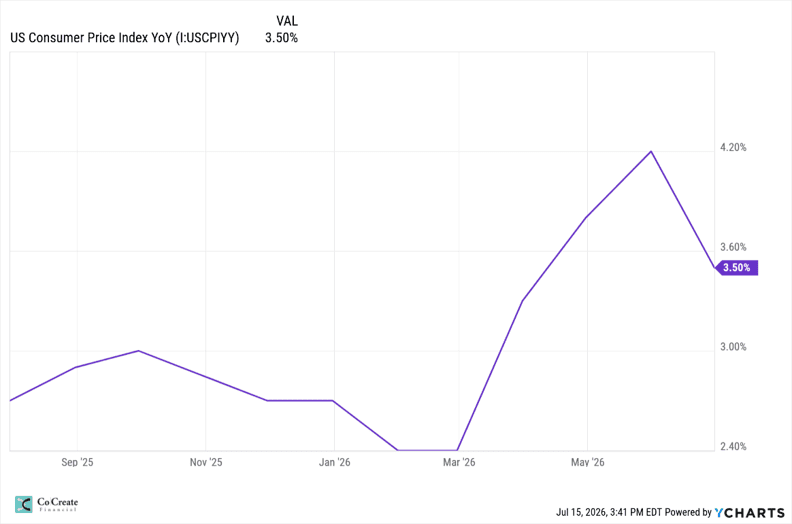
Few topics have received as much attention this year as inflation (again, nothing new), with changing feelings and predictions continuing to influence investors. CPI, or Consumer Price Index, is a measure of how much prices are changing for everyday goods and services over time. The U.S. Bureau of Labor Statistics released a report on July 14, 2026, that stated that CPI was 3.5% as of late June, meaning inflation has risen 3.5% year-over-year. When we look at the month-to-month numbers, inflation has decreased by 0.4%, largely due to the index for energy falling 5.7% in June after increasing consistently in March, April, and May. The question is whether that downward shift will continue into July as uncertainties surrounding the conflict in the Middle East continue to put pressure on energy prices.
While inflation has cooled considerably when we compare it to previous years, it remains high enough that the Federal Reserve, our nation’s central bank that is tasked with using different tools to keep our economy stable, is expected to take a cautious approach before lowering interest rates. For the everyday person, persistent inflation means everyday expenses like groceries continue to cost more than they did a year ago. For investors, inflation is one of the biggest drivers of interest rate decisions, making it an important indicator to watch. But the truth is, interest rates aren’t what drive markets, we can look at what people are investing in to see what the true drivers are.
In recent years, markets have scrutinized every Federal Reserve meeting and public comment closely, often reacting sharply to even small hints about future interest rate decisions. Since taking office, new Federal Reserve Chairman Kevin Warsh has signaled a different approach. Rather than providing detailed guidance about future policy, Warsh has emphasized that markets should focus on the underlying economic data instead of trying to anticipate the Fed’s next move. This is a step in the right direction and a huge positive for investors. Financial markets work best when they are free to move organically and are not being driven by constant speculation over recent headlines on each and every Federal Reserve speech or meeting.
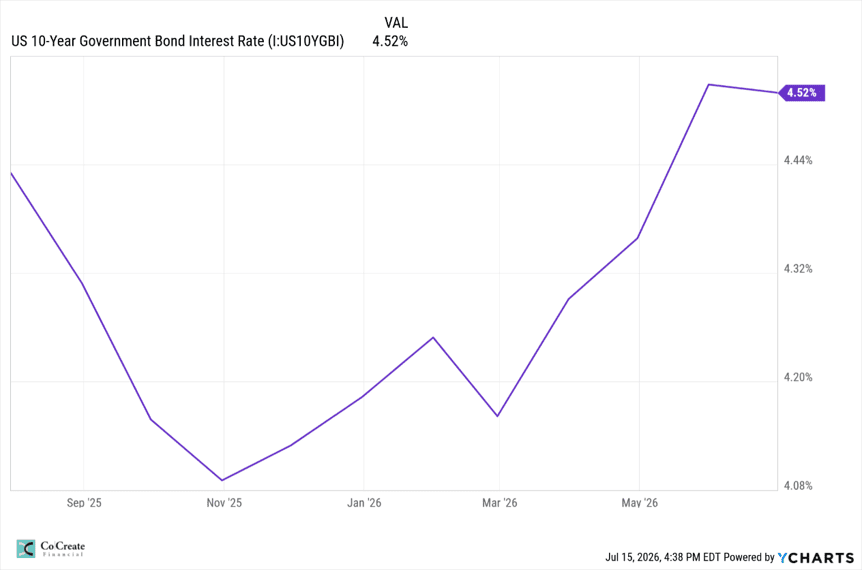
In that same vein, another important indicator to watch is the 10-year U.S. Treasury yield. Closely tied to inflation, the 10-year U.S. Treasury yield is the interest rate investors receive for lending money to the U.S. government for ten years. This rate has a heavy influence on mortgage rates and long-term borrowing rates. But it is important to note that the 10-year U.S. Treasury yield is different than the Fed Funds rate, which has more of an influence on short-term borrowing. Over the past few months, the 10-year Treasury yield has climbed to approximately 4.5%, reflecting expectations that interest rates may remain elevated while inflation continues to moderate. Higher yields generally increase borrowing costs for consumers and businesses, which can slow economic activity.
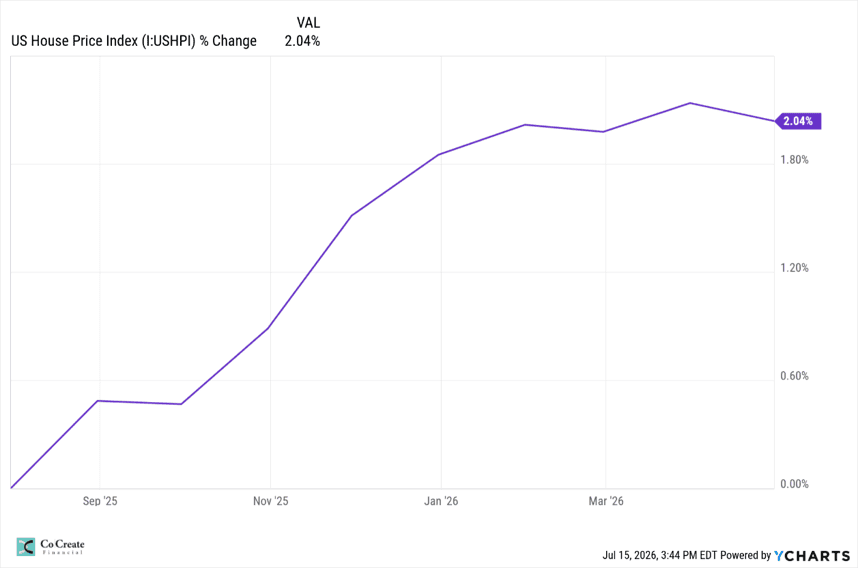
The state of the housing market is another popular topic often on the minds of many Americans. The U.S. House Price Index shows home prices continuing to rise at a modest pace, with annual growth of approximately 2.0%. While higher mortgage rates have made buying a home more expensive, limited housing inventory has continued to support prices by keeping supply tight. So, we’re in an environment where we can do one of two things: hope for rates to come down or build more! Although affordability remains a challenge for a lot of Americans, the steady pace of price appreciation suggests the housing market has found a healthier balance after the rapid gains seen in recent years.
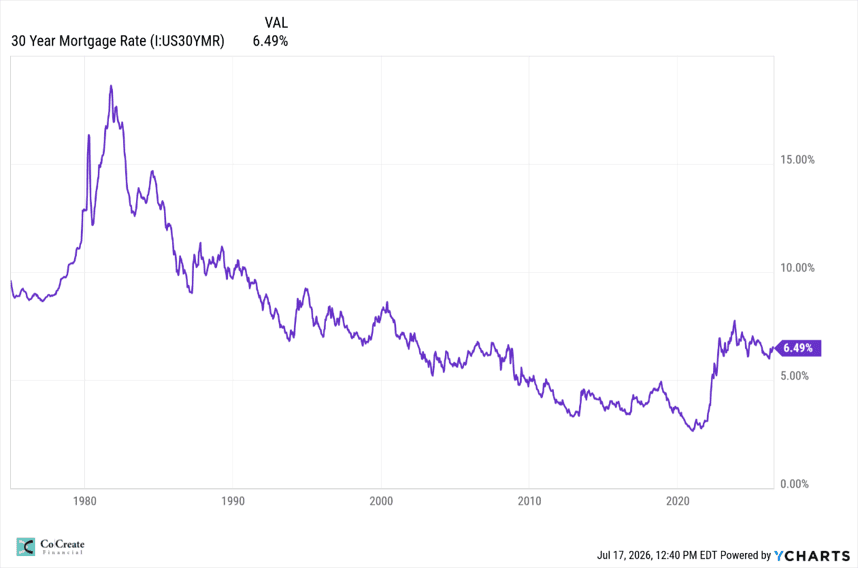
Additionally, mortgage rates of around 6%-6.5% are healthy and historically neutral. Current rates just feel high since we experienced dramatically suppressed mortgage rates after the 2008 housing crisis up until rates started to rise post Covid. The graph below shows how the 30-year rate has changed from 1975 all the way up until 2026, so when we take a more bird’s eye view, current mortgage rates are not in a crazy, rough place.
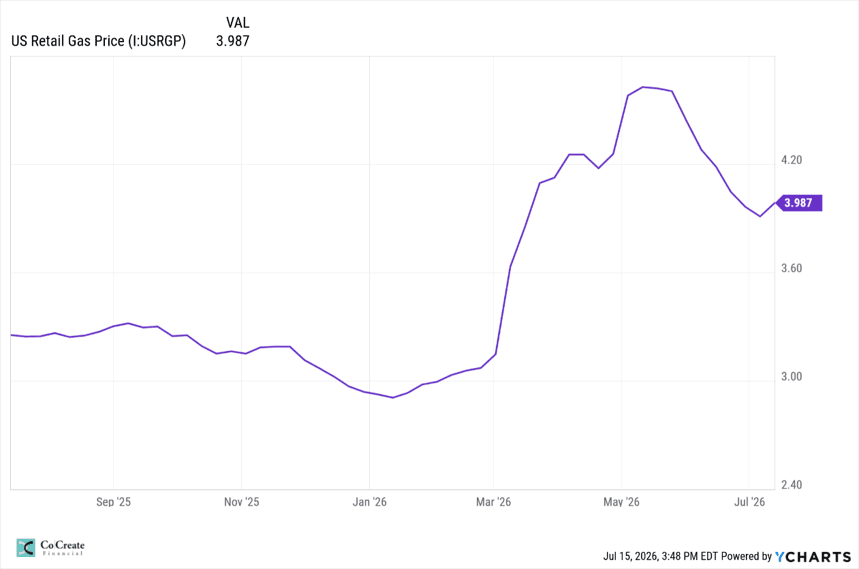
Along with inflation and the housing market, gas prices remain a major concern for many people. Looking at the graph above, we can see that the national average gasoline prices increased sharply this spring before easing slightly in recent weeks, with prices currently averaging around $3.99 per gallon. Gas prices are heavily influenced by crude oil prices, global supply, refinery production, and geopolitical events. Because fuel is a necessary expense for most households, higher gas prices decrease disposable income and can contribute to broader inflation over the long term, while lower prices provide people with more spending power.
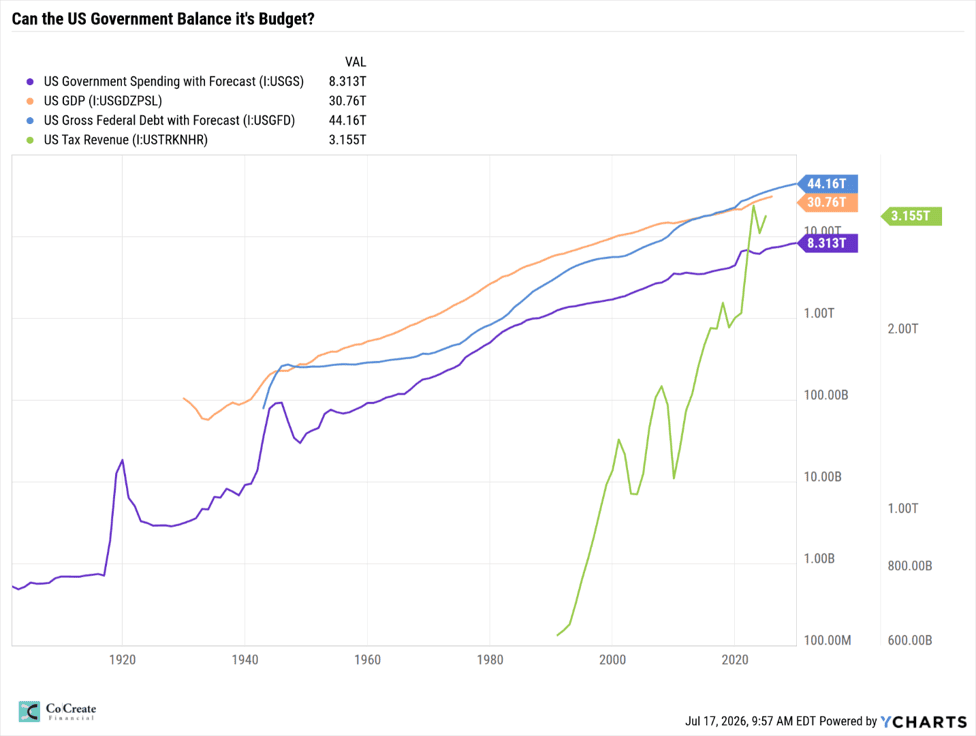
It is no secret that the United States government has a huge debt problem. This chart compares four key indicators of the health of the U.S. economy: government spending, tax revenue, gross domestic product (GDP), and total federal debt. GDP is the total value of all goods and services produced in the United States each year and is commonly used to measure an economy’s size. Ideally, as the economy grows, tax revenue also grows. However, government spending has consistently outpaced tax revenue, creating an annual budget deficit, which is the difference between what the government spends and what it collects in taxes. Those yearly deficits accumulate over time (and accrue a ton of interest), becoming the national debt we see today.
But what does this mean for investors? Rising national debt doesn’t mean the economy or stock market suddenly stops growing. It does mean that the government has less financial flexibility and will eventually have to make a choice between raising taxes or reducing their spending (hopefully they will not choose option C which is to just keep accumulating debt and interest). While there are unknowns about what exact strategy Washington will decide to take, it doesn’t change the significance of staying invested and focused on a long-term plan.
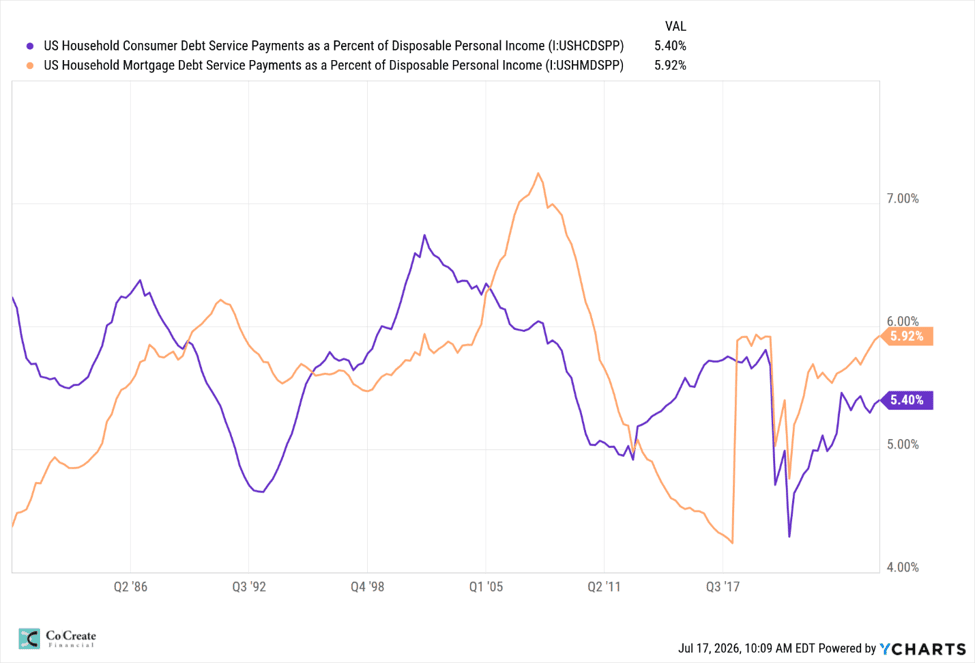
While we are on the topic of debt, let’s look at it from a U.S. household perspective. This graph offers a good illustration as to where we are at as a country on household debt levels by showing the percentage of disposable income (amount of money left after taxes) that U.S. households spend on mortgage payments and consumer debt payments like credit cards, auto loans, and personal loans. Despite higher interest rates over the past few years, debt service payments remain near historical averages. Much of this resilience comes from homeowners who locked in super low mortgage rates around 2020 and people who have generally maintained steady income growth. While financial stress certainly exists in many households across the U.S., the broader picture is relatively solid. One thing to note is that it is clear that that percentage is on an upward trend as more people finance purchases at today’s interest rates. While this is a trend worth watching over time, current levels suggest that, overall, U.S. households remain in a relatively strong financial position. As long as employment stays steady and incomes grow, household balance sheets should remain supportive of the broader economy.
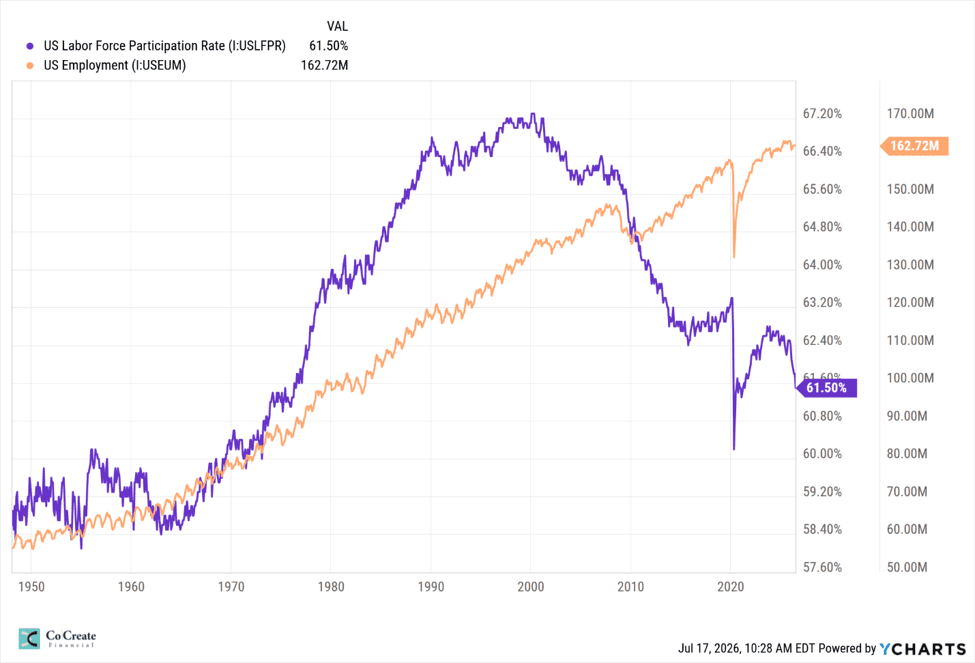
Speaking of employment, the graph above compares two different measures of the labor market: the total number of Americans who are employed and the labor force participation rate, which measures the percentage of working-age adults who are either employed or actively looking for work. While employment has recovered from pandemic lows, the labor force participation rate remains well below its peak from the early 2000s. In other words, there are more Americans working than ever before, but there’s a smaller share of the working-age population who are participating in the workforce.
Several long-term trends have contributed to this shift, including an aging population, increased early retirements, and, in some industries, a mismatch between the skills employers’ need and those available in the workforce. On the positive side, we have seen the number of unemployed workers and job openings fall relatively in line with one another on a national scale. Of course, there will be variations across industries and local economies, but broadly speaking, the United States has bounced back from the labor shortage it experienced in prior years.
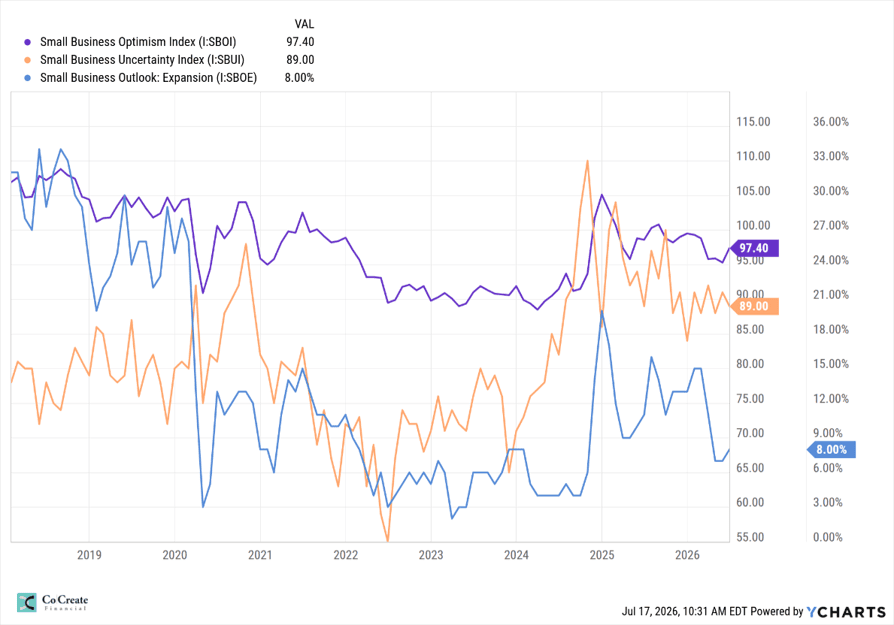
Small businesses are often considered the backbone of the U.S. economy, so their outlook can provide valuable insight into where the economy may be headed. This graph tracks three measures: small business optimism, uncertainty, and plans to expand in the future. While uncertainty remains elevated compared to past levels, optimism has begun to stabilize and businesses are once again showing a greater willingness to invest and grow. Although many business owners continue to face challenges such as higher borrowing costs and labor shortages, the overall trend suggests confidence is gradually improving, which is an encouraging sign for future economic growth.
One of the largest sources of headlines this year has been the conflict involving Iran and Israel. Investors are closely watching developments there since the Middle East produces a significant share of the world's oil, and disruptions to shipping through the Strait of Hormuz, one of the world's busiest oil transit routes, could reduce global energy supplies. Recent tensions have already contributed to higher oil prices and renewed volatility in energy markets. Higher oil prices can eventually work their way into inflation by increasing transportation and manufacturing costs, so it is something to keep an eye on.
Artificial intelligence has been one of the strongest drivers of stock market performance over the past few years, particularly among large tech companies. While AI could represent a transformational long-term opportunity, investors have recently become more selective as valuations have climbed to historically high levels. Rather than questioning AI's potential, the market is beginning to ask whether current stock prices already reflect years of future growth. Companies will increasingly need to demonstrate that heavy AI investments are translating into meaningful revenue and profits, not just speculative growth. I have no doubt that AI will continue to revolutionize innovation and continue to become more useful in daily life, but which companies will come out as winners is where the unpredictability lies.
One potential theme to watch in the coming months is a rotation from high-growth, AI driven tech stocks toward more value-oriented companies. When we think of value-oriented companies, we think of the businesses that are stocking our grocery stores, keeping our lights on, and supplying everyday products we rely on without a second thought. These are companies that provide essential goods and services you and I will continue to use regardless of the economic environment. As investors become more selective and question whether current AI valuations fully reflect future earnings potential, investments may begin shifting toward sectors with lower valuations, more stable cash flows, and established businesses. While artificial intelligence is expected to remain a powerful long-term growth driver, markets often rotate leadership as expectations evolve so we will continue to monitor if any major shifts start to emerge.
We’ve spent some time talking about the challenges in the investment world, but there are also many reasons to remain optimistic. As we celebrate America’s 250th birthday this month, it’s a fitting reminder that innovation, entrepreneurship, and resilient businesses have long been drivers of economic growth and prosperity.
While much of the market’s attention has been on AI, there are many high-quality companies out there with strong leadership, healthy balance sheets, and consistent earnings that continue to create long-term value for their owners and consumers. Corporate earnings have stayed strong, showing that success isn’t only found in a handful of dominating companies.
Artificial intelligence is also entering a new phase. Rather than simply generating speculative excitement, businesses are increasingly finding new ways to apply AI practically to boost productivity and efficiency. As adoption across sectors expands, opportunities may go beyond the companies developing AI to those using it to strengthen their business models.
While productivity gains from major technological advances can take years to fully materialize, history suggests that patient, long-term investors are often rewarded as innovation becomes more embedded across industries.
The challenges we’re seeing today are not out of the ordinary to long-term investors. Markets will always have ups and downs, and today’s environment is no exception. Geopolitical events and changing expectations around artificial intelligence may continue to create short-term volatility, but they don’t change the long-held principles of disciplined investing.
Rather than reacting to every headline, we believe it’s important to stay focused on what matters most: owning high-quality businesses, maintaining a strategically diversified portfolio, and keeping your investments aligned with your long-term goals. Taking a calculated diversification approach allows us to avoid putting all our eggs in one basket, helping create a more resilient portfolio over time.
History reminds us that patient investors have been rewarded over time. Since 2000, the S&P 500 has delivered average annual returns of roughly 8%. While long-term market growth is an important driver of accumulation, successful investing is about more than simply participating in the market. A thoughtful financial plan includes a well-designed distribution and liquidity strategy, ensuring you have cash available when you need it without being forced to sell investments during periods of market downturns. This approach helps make retirement income more sustainable while allowing the rest of your portfolio to remain invested for long-term growth.
Above all, we believe successful investing is about more than managing a portfolio, it’s about helping navigate what we can’t control with confidence and what we can with clarity. Markets will continue to evolve, but your financial plan should provide you with stability through every stage. We remain committed to helping you make thoughtful decisions, adapt when needed, and stay focused on the goals that matter most to you.
2026.03.16 Podcast Episode 2
Matt Hudak: Hi friends. My name is Matt Hudak. This is Christa Hudak. If you haven't had the chance to meet us, we're really excited that you are exploring CoCreate Financial and checking in on how we invest. That's what we'll be talking about today in our video. Just a little bit about our investment philosophies, how we approach each client's asset allocation, all those different things.
I promise we'll do it in plain English and it should make a ton of sense and hopefully inform your decision and our exploration process so that when we connect in person, we're able to focus more on the specific questions that you have, and less on just us talking at you about investment things that you probably don't even care about all that much.
So we're going to dive in and kind of talk about how we structure this.
Christa Hudak: Before we get into the specifics of talking about investments, the first thing we want to take a step back and consider is how we view a financial picture and making sure our clients have a setup that leads to their financial freedom.
And when we do that, you know, the very first base level that we always make sure with all of our clients is that they have appropriate cash reserves and then we bucket their assets. And this works both from the standpoint of cash management, of cash flow management, of just your regular income and also with your investment assets and how we approach it.
And we have this graphic that will show up on the screen as well that's something we use as we have this exploration for everyone. And the first thing that we always want to consider is that your basic needs are being met, right? So that you're paying your mortgage, you're able to eat reasonably, you're covering all the necessities in life.
And this is, like I said, true both for cash flow and then also when we're doing long-term planning and retirement planning, is that we really want to protect the chunk of your assets. And pay special attention that your basic needs are met throughout your life. But the reality is everybody, most everybody wants something a little bit more than just the bare minimum.
And we call that your adventure bucket. And this looks different for different people. Maybe it's living in a little bit nicer of a house or going out to eat or travel plans or all kinds of extravagant, fun things that we enjoy in life.
Matt Hudak: Yeah. It's the extras.
Christa Hudak: Yeah. That you're like, oh, I don't need this to live, but this is the thing that makes life fun.
And so we want to make sure we cover your basics. And then we also want to make sure that we're covering things that accomplish the things that you want to do in life. And somewhere in that range, there's what we call like enough. Sometimes people will talk about it as like a financial freedom line or a financial finish line of this recognition of, hey, I can be content at this level and satisfy the things that really matter to me, but that doesn't mean that that's all that there is to do, or maybe you have resources that exceed that. And so sometimes there's more adventure to be had. And then we also look at this idea of an impact bucket. And this can be the crazy projects or maybe it's a lot of gifting to family members or maybe some generosity of charitable giving.
Matt Hudak: Yeah, it might be pursuing business growth, a lot of those different pieces. So what does that look like in terms of when we're looking at somebody's assets, how much do we typically see in terms of need with that, like covering the basics to produce income, to cover your basic needs, what might that adventure bucket then look like beyond that?
Christa Hudak: Well, to be completely honest, this is very unique for everybody because we see a wide variety of just lifestyles and what people engage with and also different setups in it. There's different components in this that adjust those numbers both from the standpoint of what you are going to consume from it.
Maybe you just tend to live a simpler lifestyle and are very content with that. Or, also other income that comes in. So depending on what social security income looks like, or if somebody has pension income. The needs for those assets in that bucket to cover the basics goes down, but typically we see the basics and a little bit of adventure included when we have clients in the one to two million range with some additional income like we talked about. That's pretty typical.
Matt Hudak: Awesome. Yeah. And we'll fund that basics bucket typically with a portfolio of you know, dividend yielding stocks. We might fund that with some fixed income. We'll talk about what those things are in just a moment, but we'll look at really liquid, really secure things within the adventure bucket.
We'll probably look at more things like real estate rentals, those types of investments, they might be really stable income, except they've got some concentrated risk. You know, something goes wrong and the tenant doesn't pay. It's a big hit. So it's like they work well, but when they don't work, they really don't work for a period.
So we don't want to take those risks with your basic needs. But some of the adventure bucket, those [00:05:00] things kind of come into play there. And then in the impact bucket, we're looking at private equity and some impact investing sometimes like that. Things that can really do good in the world, solve hunger problems or human trafficking issues and make a profit at the same time.
So we look at all those different pieces but as you go up in those tiers, across those buckets, you have the ability to take some more strategic risks to accomplish great things because you're not needing those. But we also want to protect what you really need. So when we're doing that here's kind of what it looks like. There are a couple fundamental philosophies that we really hold to. We take a very business-minded approach to how we invest. So when you're looking at an investment with us, what we're doing is we're thinking about it like the business that we own.
The business that you, if you're a business owner and you own a business, we're thinking about the same way you would think about buying an individual business or making an individual loan or doing something like that. We make sure that we're really making smart decisions. The second thing that we've done is we've really taken a philosophy that clears [00:06:00] away a lot of the clutter from the complex investment products and the investment theories that really haven't added a lot of value to our ability to create returns in a portfolio.
They've added a lot of complexity. Some of them have added things that actually create new problems that we didn't have to deal with before, those types of theories. So we really take a very clean and simple approach that makes a lot of business sense.
Matt Hudak: And then we use a discipline process with that, and it allows us to maintain a laser focus on every investment that we own across our whole entire client asset base. And it actually allows us to measure things like diversification. It used to be that diversification was just owning everything and seeing what worked and what didn't, and you just kind of offset different types of things very generally, and it was a very kind of shorthand approach.
We take a very focused strategic approach where we can put numbers to this, and we audit that every month and debate that and discuss that as a team to make sure that we're appropriately managing our [00:07:00] client accounts at an investment level, at a very granular level, and we can specifically evaluate because of that, the specific business risks, the specific investment risks that exist with each investment, rather than just trying to monitor, you know, up and down fluctuation at the pricing in your account.
What's the actual risk that you have in that investment? What's the actual reward and how do we mitigate those strategically on a one-on-one level with each investment?
Christa Hudak: So Matt, do you want to back up and kind of show us how we view investments at their core?
Matt Hudak: Yeah, absolutely.
And we'll focus if it makes sense, we'll focus on just kind of this basics bucket, this more liquid style. When we get into the individual real estate properties, the private investments that someone might make, those are so individualized and they're so different from one to the next that we have to take a very focused approach in the context of our meeting, if that's you, but the first couple million dollars, like where we went, we were talking about will be in this basics bucket. So I'm going to go [00:08:00] ahead and pull up a whiteboard here and share this with you.
And kind of go through how we think about investing in general. So when you are making investments, it's not really owning markets or indexes or averages, it's not complex. It actually boils down to two things and there's kind of a third. That's the real estate side of things, but it fits kind of into the business ownership concept that we'll talk about.
The first thing that you can do is make loans.
I'm going to hold this because it's bouncing a little bit. So you can make loans and the other thing that you can do is you can own businesses. Own businesses. There we go. So when you're making a loan to somebody, I want you to think about this a lot like you're lending money to a friend. If you've done that at some point, or maybe even somebody that's not a friend, a random stranger, I don't know, that's one of the questions you have to ask.
If you're making this loan, think about what you're going to ask this person that you're lending to. You know, do they have a source of income to pay it back? What's the loan for?
Christa Hudak: When do they say they're going to pay it back?
Matt Hudak: Yeah. When do they say they're going to pay it back? Are they going to pay you interest?
Have you ever lent them money before? What do they do with it? Did they pay you back? All these questions we evaluate when we're looking at making loans as an investment. The only difference is you're making these investments to usually large corporations, governments and you're evaluating that on a case-by-case basis.
It's very different to make a loan to the city of Detroit than it is to the United States government than it is to Nigeria or to Coca-Cola. So it just depends on that mix. And we have to ask these questions. So what happens when you're making these loans is let's say it's the city of Bozeman, since we're located in Bozeman, and we're going to create an imaginary scenario here.
So the [00:10:00] city of Bozeman wants to lend money and they say, you know, if you give us a thousand dollars, 'cause they'll go to the public and do these incremental loans. So they'll say, if you give us a thousand dollars and let us keep it for 10 years, we're going to pay you a thousand dollars back in 10 years.
And that sounds like that'll work pretty well for, you know, keeping your thousand dollars stable. What I'll say is this thousand dollars, 10 years from now, isn't worth what a thousand dollars well by today it's, you know, a movie ticket used to cost and nickel kind of concept.
Christa Hudak: And Matt, what are they using this money for?
Matt Hudak: I don't know, maybe another high school. We could use a third one here in town.
Christa Hudak: Probably.
Matt Hudak: Yeah. So, in return for this, where you're going lend them the money, they're going pay you, let's say $60 a year. Okay? So that's 6% interest. If you're like me and struggle with math from time to time.
So, they're [00:11:00] going pay you $60 a year and that's going continue each of these 10 years until you get your principal back. Well, let's say in two years you want, and I don't know if there are 10 tick marks here, by the way, so don't count that. But if say in two years you need your principal back 'cause you want to buy a car or you want to do something fun, whatever it might be.
Well, if you go to the city of Bozeman at that point in time, they have no obligation to give you your money back. So they might just tell you to kick rocks. In fact, that's kind of generally what happens. So there's a system where if you want your thousand dollars back, you go out to the general market and it's a format.
It looks a lot like Craigslist but existed way longer than Craigslist has. But you go to this system where we post this for sale and then somebody says, yeah, I want that loan, or I don't want that loan. And what happens when you do that is if the city of Bozeman instead of $60 is paying [00:12:00] $80 now, well the person that's going to buy this from you is going to want, you know, to get a little bit of a discount on the price because they can get more interest if they just go straight to the city of Bozeman. And the opposite is also true. If instead of $60, they're paying, you know, $50. Then you're going to call and you're going to know that, then you're going to call the city and find that out, and then you'll end up offering to sell this for a little bit of a profit.
And so these prices, we call these bonds by the way. We try to avoid the jargon when we can. So in this mix, these bonds that these loans that you make move the opposite direction of interest rates. So when interest rates rise, the price of the bond goes down and when interest rates decline, the price of the [00:13:00] bond goes up.
So we believe that these investments work as they are, right? They're great. If you need to get $60 a year and you're fine with the thousand dollars being worth a little bit less because of inflation and ten years from now, that's a phenomenal product. It works really, really well. It's stable. Some of these are secured too against property. That's why there's a little bit of a myth, but that's why bonds are seen as more secure than stocks.
Christa Hudak: And you have a specific contract of how much you're going to get.
Matt Hudak: Yeah. And so you get some protections that can exist within those from default risk and stuff like that.
But within this it works if you're going to own that as an individual investment for that period, and you're comfortable holding it until it matures. A lot of times what we see though is these are held in funds for people and if you have a bond fund in your portfolio, what they're actually doing is they're often trading those bonds so that they can [00:14:00] get some extra yield.
So maybe they can make a profit as interest rates are declining and they have to also create the fund, the money to liquidate and to pay people out when people want to pull money out of their funds. And so there's some functions where a lot of times they're trading these bonds to make a profit rather than owning them for the interest.
And it creates a scenario where it's really almost just as much of a day-to-day fluctuation as the stock market, it's not the same amount of volatility if you measure it in a percent, but it's relative to what you're getting out of the bond. It's actually pretty similar, and they don't necessarily move in an opposite direction when you really need 'em to.
Christa Hudak: Another thing that we frequently see, as Matt discussed earlier when you are evaluating making a loan to somebody, you want to know whether or not they're going to pay you back, and that should impact the interest rate that you're going to get in receiving that if you feel like something's not very likely to pay you back, you might say, hmm, to compensate for this risk, I need a higher rate of return.
And one of the things that we frequently see [00:15:00] as we look at portfolios is where people hold bond funds that are specifically labeled high yield bond funds. And another technical industry term for that is actually junk bonds. And what these are is low quality, below investment grade loans that have a high risk of default and not paying on them.
And so they're able to get a much higher yield and well, sometimes it works well, but there's also a risk that those stop being paid, so they tend to be less secure as well.
Matt Hudak: Yep. And we kind of look at yield as interest rate, and that's another jargon term that we often use and sometimes, or avoid, it's basically like a rate of payout.
So, in this case, it's the interest rate that you receive from the bonds. So the higher the interest that you get, the more risk there is of default and other issues with the bond.
Christa Hudak: So Matt what's the other side and owning businesses?
Matt Hudak: The other side of this is owning businesses. You read my mind. It's underlining it right there. And owning businesses really [00:16:00] this is the function of the stock market. It was what it was designed to do. It was a way for you to own a tiny fraction of a large business and have the right, a lot of the rights of an owner, the rights to vote, rights to profits, all of that from the business.
And so when we look at the stock market, rather than trading the stock market day to day to get price, like price increases and get a capital gain here or there and take profits from it and maybe make money, maybe lose it, rather than treating the markets like a casino, whether that's day to day or on a longer, slightly longer term basis. We look at it as a way to own a business that you would want to own. And you can think about that a lot like owning a taco truck. This is my favorite analogy 'cause I love tacos, but it always makes me hungry. So tacos later! When you're owning a business, and just by the nature of kind of how our industry works, we're not going to talk about the specific companies, not because we're not happy to share how we do this in specific terms, but I don't want to lead you on that. You know, a company we're [00:17:00] going to talk about specifically is a good investment and then a year from now have something change and have you watch this video and then try to replicate what we're talking about and have it not work. So, we're going to talk generically, so you're going to own a business and there are so many of these, think about any of the corporations that you've seen and maybe you can put a placeholder in. When we're looking at this business, they've divided it up and it might be into millions and millions and millions of fractions, and you're going to want to own this little piece of it.
And so the company sells products. Maybe they make deodorant and personal care items or whatever.
Christa Hudak: Or maybe they make tacos.
Matt Hudak: Or maybe they make tacos. And you're going to get a portion of that earnings in the business, they're selling products like tacos. So if you're going to buy this taco truck, right, and let's say you're going to buy the whole thing because it's a taco truck and it's not a major corporation, but you're going to buy the taco truck. What questions are you going to ask?
You're [00:18:00] going to ask, you know, what does it cost to make a taco. What do beans cost? Do I have to hire people to run this or am I going to run this myself? Do I have old debts that I have to pay off? Will I have to finance the taco truck? Do they have a retirement plan where there's going to be obligations coming up? What's kind of the makeup of this? You're also going to ask, do people want tacos?
Matt Hudak: And I think we all know the answer is always, but when we're looking at this, we're going to look at the details of that business. And at the end of the day, no matter how much I love tacos, and hopefully you have a feeling for that at this, at this point, that no matter how much I love tacos, I can't buy the taco truck if it doesn't pay me at the end of the day.
That's the fundamental nature of business ownership is that it has to pay you a paycheck. If it doesn't, I'm better working a real job and going and getting tacos.
Matt Hudak: So from that standpoint, we have to look at these major corporations from that same lens. And when we do [00:19:00] that, it's really shown to work when we test this throughout history with less risk than most other things and more return. And that relationship looks really attractive when we just take the simple approach.
Christa Hudak: When we're looking at businesses in the stock market, one of the things to remember when we talk about risk, we're really talking about these fluctuating values.
And that's really the thing that causes some stress, right? In stock market investing is how much fluctuation do you see? So we always think of it as a good thing when we can get the return that people want to see, but also make those fluctuations less dramatic.
Matt Hudak: Yeah. And so this really works well for it. And not all businesses that you see that are listed on the stock exchange do this. Not all businesses that are listed on the stock exchange even have a profit. You would be amazed at how many companies are actually hemorrhaging money and people are investing and paying more for them, thinking, you know, they're going to be the future someday.
But if you looked at it as a business that you were going to buy to [00:20:00] run yourself, you would turn and run away. It just is not a good business to own and we don't believe in doing those kinds of things. We like to own good businesses. So let's say this business that we're talking about that brings in $3, whether it's a taco truck or
a tech company.
Christa Hudak: $3 for each share.
Matt Hudak: Yep. For each share for each one of these fractions that you might own. So it's bringing in $3 and in that it's going to pay out or we're going to want to see it use a dollar. And this is approximate. Let's say it's going to keep a dollar in reserves because it might need to build a new factory or they might need to do something with it. Create a new product or do research. So they're going to keep a dollar. We want to see that stability going with them. Lots of free cash flow, cash reserves, but they're also going to do something magic, and they're going to pay a dollar out to you as an owner.
Matt Hudak: And we want to see that. If a company doesn't do this, it's a sign that the company's not really mature in its development yet. [00:21:00] And there are a lot of investment arguments where you can say, well, maybe is that spigot? This is a spigot. Yep. There are a lot of arguments that say maybe you can make money on that, but it's not really assured.
Matt Hudak: Like you don't know until it starts coming out. So we're going to put a spigot on here and then what we'll do is we'll say this is paying a dollar, and maybe for the last 80 years this has paid a dollar out to its shareholders or maybe it's increased it for 80 years and has paid it out for a hundred.
We want to see this income coming in consistently and rising. That means market crashes happen. It's probably still coming in.
Unless there's something truly catastrophic with the company. And we can see that hopefully from develop and build from a little ways away if we're looking carefully.
But it's paying a dollar this year and then, you know, next year, because it's always does this, it seems or almost always does this increase, it might pay you a $1.10 and then the next year it's going to pay you a $1.30. That's [00:22:00] actually tangible value to you. You can understand what that is. That's $3 and 30 cents.
Christa Hudak: And Matt, how is this amount that's paid, determined?
Matt Hudak: This is determined as a flat dollar amount by the board of directors of these companies every year. So they sit down and say, we're paying this. It's not a percent. We'll talk about this as a dividend yield. It's what we call it. And it's paid out by the board of directors. So what happens is they don't look at this as a percentage. They look as a flat dollar, and they're going to pay that, and so we hope to see a pretty good dividend on most of the companies that we own. We really like to see about about 3% or so.
Where you get this good consistent income, and that's what gives a business its value. It's the paycheck that you get, and when we're looking at it, we're able to say, you know, this $3 and 30 cents, because it's going to continue and there's a little bit more math than just simply adding it up, but not much.
This gives a business value. It gives us an enough value we can [00:23:00] appraise this business for and say, you know, it's worth it to buy this business. And we might say, this business, we will pay $50 a share is a fair price to pay for that cash flow that we're buying. And knowing that if that continues and that cash flow continues to grow, we might be able to sell it for $55 in a few years.
And that's pretty stable. If it goes up to 70 and skyrockets, we won. If it just kind of plods along, then we're still really happy. And so it gives us the ability to manage this with some reason to believe in it. And if it things go down and the market crashes, and we can probably pull this illustration down now at this point.
So we'll pull this off and just talk to you. When we're looking at this, when the markets go down then, it also mitigates a lot of risk because there's cash coming in. So not only do you have a reason to say this company has a fair market value, even though it's on sale
It's going to continue to be consistently performing over the long term, and we have a good reason to believe that. It also means that we get cash coming [00:24:00] into your portfolio on a day-to-day basis, or on a month to month basis, where that cash that's going to come in is going to be able to buy shares at a lower price or distribute cash where we don't have to sell things at a loss or at a lower value for your cash flow needs.
So it really stabilizes the portfolio too.
Christa Hudak: Yeah, we view this as a great way to provide a lot of stability and also remember that there's a basis for the value of the investments that you hold. We hope that this has been helpful for you as you explore these concepts and look forward to having a conversation with you soon.
