
(406) 206-7571
The first half of the year has reminded us that the stock market rarely grows in a straight line. It has reacted to changing economic data, rumors about the future of interest rates, geopolitical events (war, changes in international trade policy/preference, etc.), Congress’s inability to function, and continued drama around investing in artificial intelligence. In the midst of the instability, we have seen strong returns in the first half of the year.
On one side, we’ve seen people recognize much of the instability that shows up in the headlines. When we speak with these people, we look at history, which reminds us that markets have consistently rewarded disciplined, strategic, long-term investors who don’t forget about the basic rules of investing. Time in the market matters, and not every business has the same risks. When you look at each business in your portfolio on its own merits, and take care to put them together so they complement each other, most of the headlines just become noise.
On the other side, we see many looking at the easy money promised by the AI investment craze. We would remind these people of the old adage “easy come, easy go”. We’ve long said that if it sounds too good to be true, it probably is. Investing indiscriminately in the stock markets at this stage certainly reflects these principles. Good investors aren’t like my dog, Stetson, when he sees a squirrel. They don’t let themselves be distracted by the newest, shiny thing. Instead, they repeatedly buy good businesses that provide consistent passive income.
Market fluctuations happen every year, and 2026 is no exception, but there are also many exciting opportunities on the horizon! In this month’s update, we’ll take a closer look at the current economic landscape, discuss key themes influencing markets today, and share our perspective on what they may mean for you moving forward.
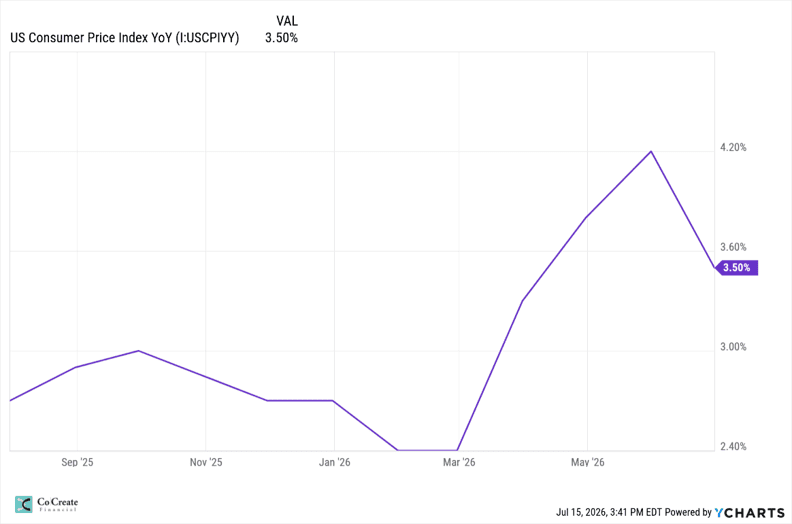
Few topics have received as much attention this year as inflation (again, nothing new), with changing feelings and predictions continuing to influence investors. CPI, or Consumer Price Index, is a measure of how much prices are changing for everyday goods and services over time. The U.S. Bureau of Labor Statistics released a report on July 14, 2026, that stated that CPI was 3.5% as of late June, meaning inflation has risen 3.5% year-over-year. When we look at the month-to-month numbers, inflation has decreased by 0.4%, largely due to the index for energy falling 5.7% in June after increasing consistently in March, April, and May. The question is whether that downward shift will continue into July as uncertainties surrounding the conflict in the Middle East continue to put pressure on energy prices.
While inflation has cooled considerably when we compare it to previous years, it remains high enough that the Federal Reserve, our nation’s central bank that is tasked with using different tools to keep our economy stable, is expected to take a cautious approach before lowering interest rates. For the everyday person, persistent inflation means everyday expenses like groceries continue to cost more than they did a year ago. For investors, inflation is one of the biggest drivers of interest rate decisions, making it an important indicator to watch. But the truth is, interest rates aren’t what drive markets, we can look at what people are investing in to see what the true drivers are.
In recent years, markets have scrutinized every Federal Reserve meeting and public comment closely, often reacting sharply to even small hints about future interest rate decisions. Since taking office, new Federal Reserve Chairman Kevin Warsh has signaled a different approach. Rather than providing detailed guidance about future policy, Warsh has emphasized that markets should focus on the underlying economic data instead of trying to anticipate the Fed’s next move. This is a step in the right direction and a huge positive for investors. Financial markets work best when they are free to move organically and are not being driven by constant speculation over recent headlines on each and every Federal Reserve speech or meeting.
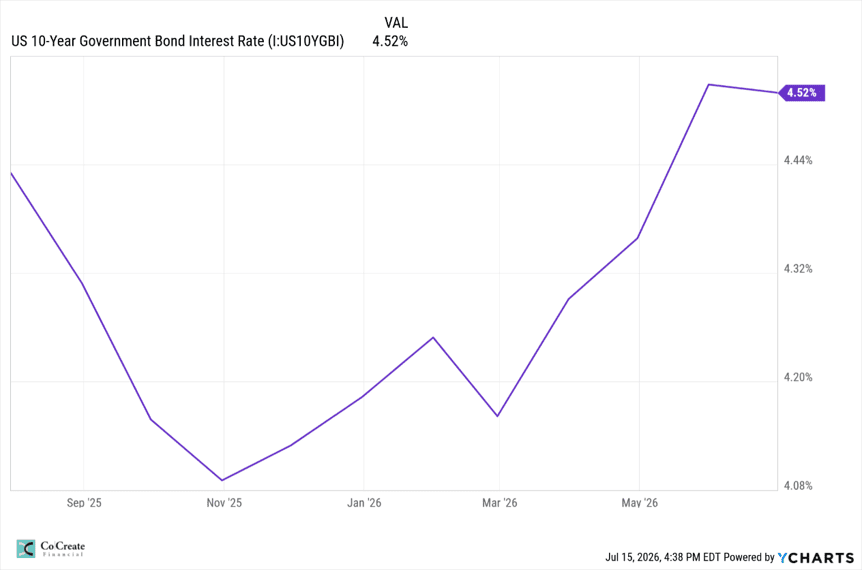
In that same vein, another important indicator to watch is the 10-year U.S. Treasury yield. Closely tied to inflation, the 10-year U.S. Treasury yield is the interest rate investors receive for lending money to the U.S. government for ten years. This rate has a heavy influence on mortgage rates and long-term borrowing rates. But it is important to note that the 10-year U.S. Treasury yield is different than the Fed Funds rate, which has more of an influence on short-term borrowing. Over the past few months, the 10-year Treasury yield has climbed to approximately 4.5%, reflecting expectations that interest rates may remain elevated while inflation continues to moderate. Higher yields generally increase borrowing costs for consumers and businesses, which can slow economic activity.
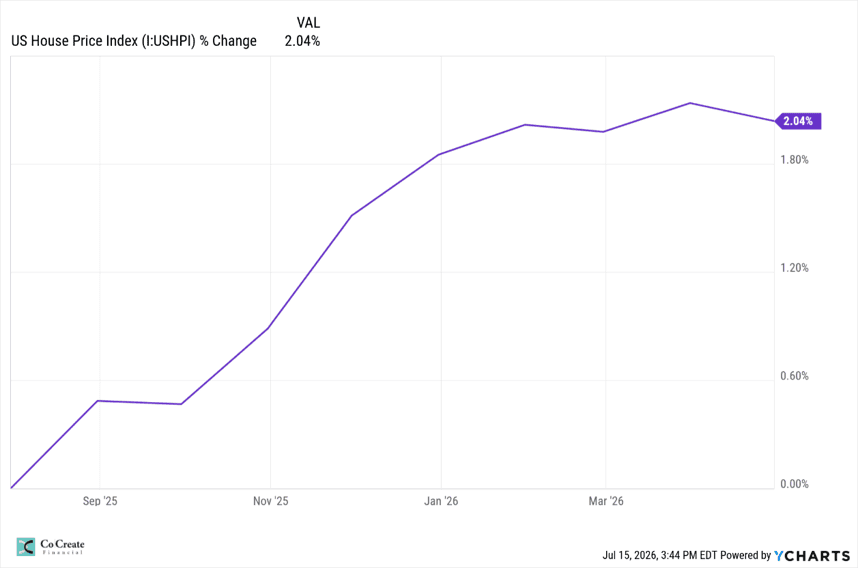
The state of the housing market is another popular topic often on the minds of many Americans. The U.S. House Price Index shows home prices continuing to rise at a modest pace, with annual growth of approximately 2.0%. While higher mortgage rates have made buying a home more expensive, limited housing inventory has continued to support prices by keeping supply tight. So, we’re in an environment where we can do one of two things: hope for rates to come down or build more! Although affordability remains a challenge for a lot of Americans, the steady pace of price appreciation suggests the housing market has found a healthier balance after the rapid gains seen in recent years.
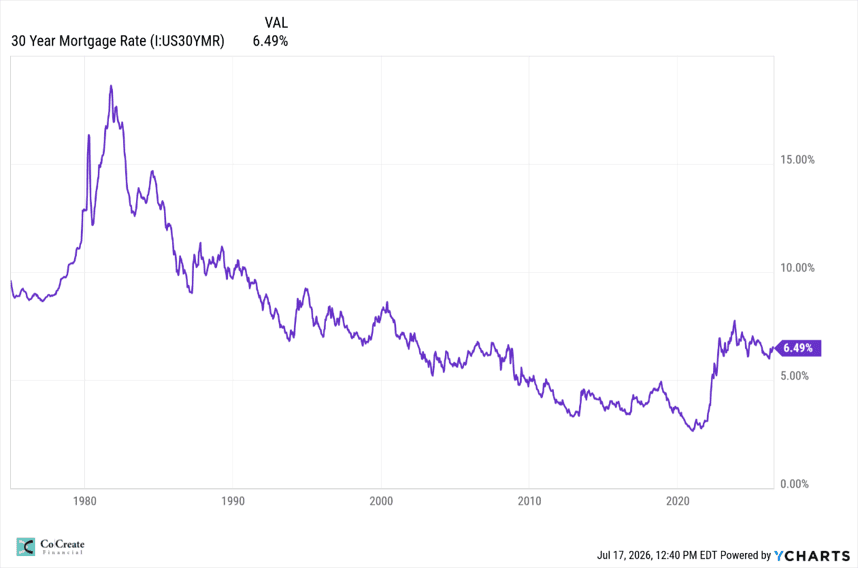
Additionally, mortgage rates of around 6%-6.5% are healthy and historically neutral. Current rates just feel high since we experienced dramatically suppressed mortgage rates after the 2008 housing crisis up until rates started to rise post Covid. The graph below shows how the 30-year rate has changed from 1975 all the way up until 2026, so when we take a more bird’s eye view, current mortgage rates are not in a crazy, rough place.
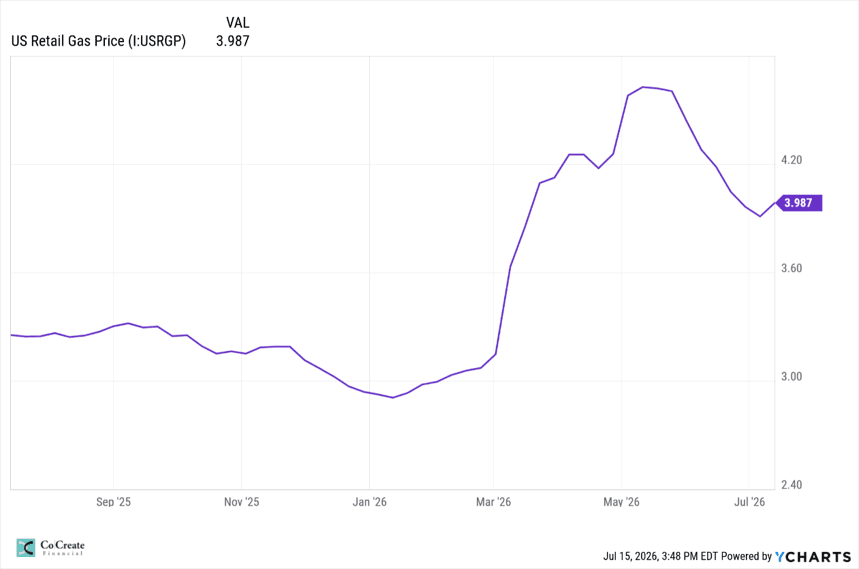
Along with inflation and the housing market, gas prices remain a major concern for many people. Looking at the graph above, we can see that the national average gasoline prices increased sharply this spring before easing slightly in recent weeks, with prices currently averaging around $3.99 per gallon. Gas prices are heavily influenced by crude oil prices, global supply, refinery production, and geopolitical events. Because fuel is a necessary expense for most households, higher gas prices decrease disposable income and can contribute to broader inflation over the long term, while lower prices provide people with more spending power.
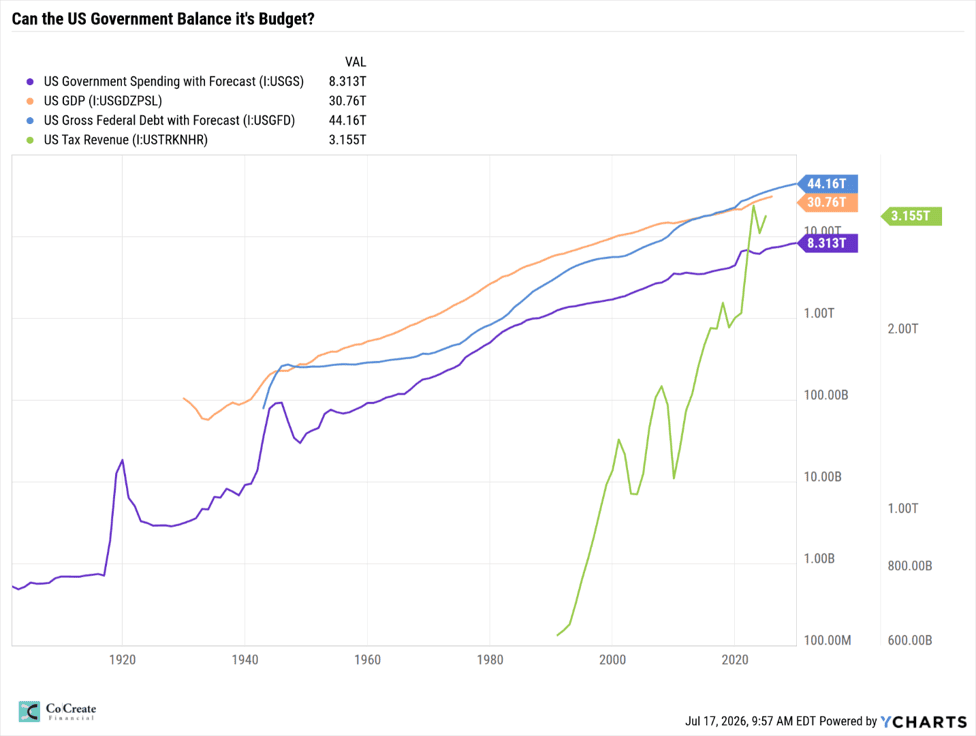
It is no secret that the United States government has a huge debt problem. This chart compares four key indicators of the health of the U.S. economy: government spending, tax revenue, gross domestic product (GDP), and total federal debt. GDP is the total value of all goods and services produced in the United States each year and is commonly used to measure an economy’s size. Ideally, as the economy grows, tax revenue also grows. However, government spending has consistently outpaced tax revenue, creating an annual budget deficit, which is the difference between what the government spends and what it collects in taxes. Those yearly deficits accumulate over time (and accrue a ton of interest), becoming the national debt we see today.
But what does this mean for investors? Rising national debt doesn’t mean the economy or stock market suddenly stops growing. It does mean that the government has less financial flexibility and will eventually have to make a choice between raising taxes or reducing their spending (hopefully they will not choose option C which is to just keep accumulating debt and interest). While there are unknowns about what exact strategy Washington will decide to take, it doesn’t change the significance of staying invested and focused on a long-term plan.
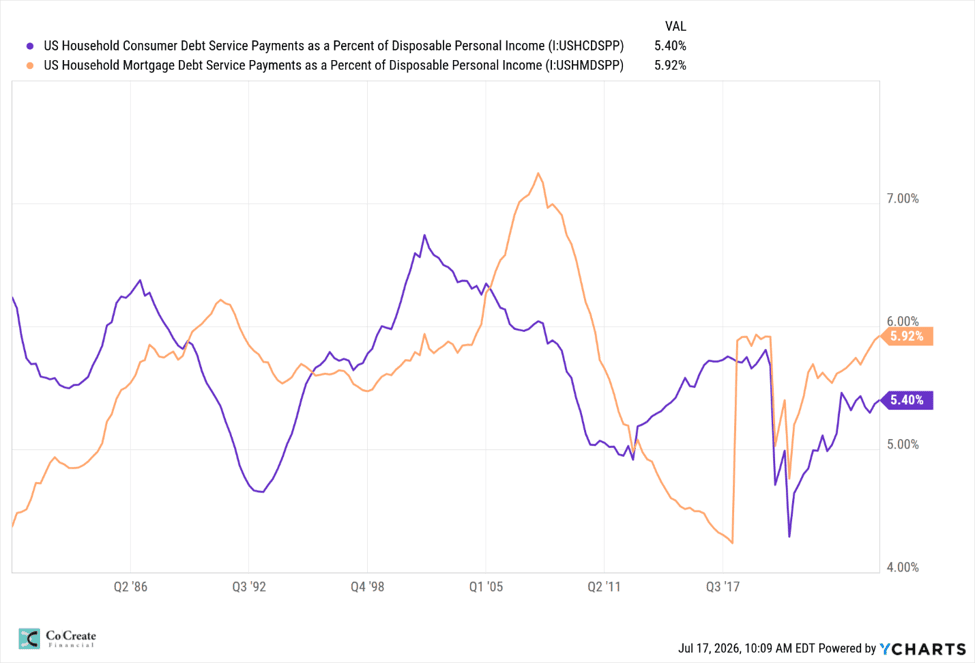
While we are on the topic of debt, let’s look at it from a U.S. household perspective. This graph offers a good illustration as to where we are at as a country on household debt levels by showing the percentage of disposable income (amount of money left after taxes) that U.S. households spend on mortgage payments and consumer debt payments like credit cards, auto loans, and personal loans. Despite higher interest rates over the past few years, debt service payments remain near historical averages. Much of this resilience comes from homeowners who locked in super low mortgage rates around 2020 and people who have generally maintained steady income growth. While financial stress certainly exists in many households across the U.S., the broader picture is relatively solid. One thing to note is that it is clear that that percentage is on an upward trend as more people finance purchases at today’s interest rates. While this is a trend worth watching over time, current levels suggest that, overall, U.S. households remain in a relatively strong financial position. As long as employment stays steady and incomes grow, household balance sheets should remain supportive of the broader economy.
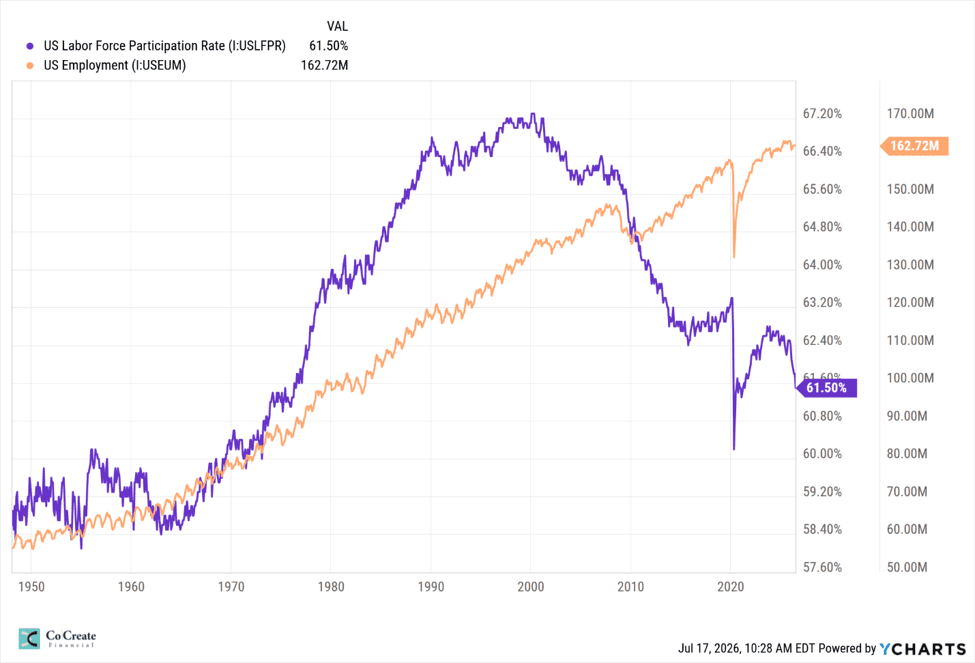
Speaking of employment, the graph above compares two different measures of the labor market: the total number of Americans who are employed and the labor force participation rate, which measures the percentage of working-age adults who are either employed or actively looking for work. While employment has recovered from pandemic lows, the labor force participation rate remains well below its peak from the early 2000s. In other words, there are more Americans working than ever before, but there’s a smaller share of the working-age population who are participating in the workforce.
Several long-term trends have contributed to this shift, including an aging population, increased early retirements, and, in some industries, a mismatch between the skills employers’ need and those available in the workforce. On the positive side, we have seen the number of unemployed workers and job openings fall relatively in line with one another on a national scale. Of course, there will be variations across industries and local economies, but broadly speaking, the United States has bounced back from the labor shortage it experienced in prior years.
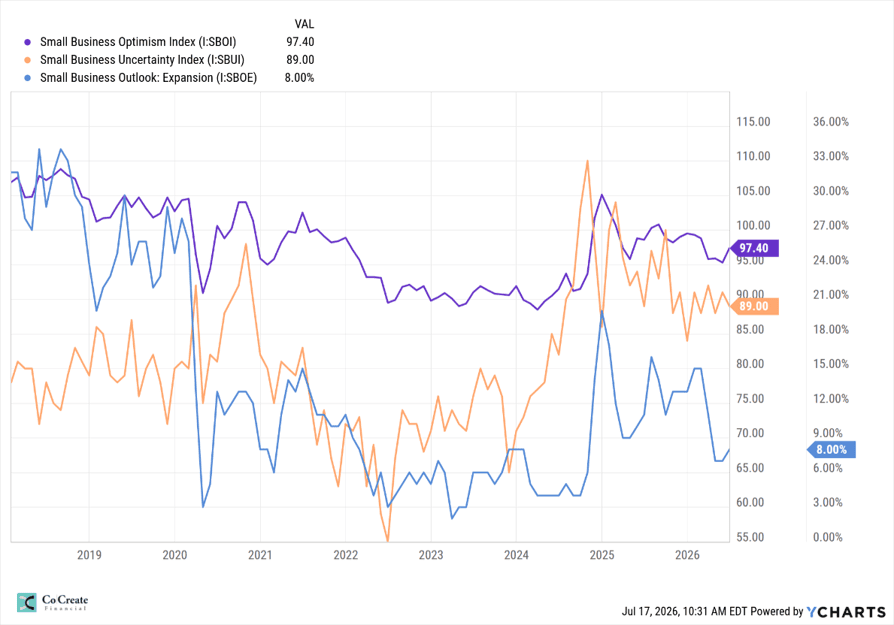
Small businesses are often considered the backbone of the U.S. economy, so their outlook can provide valuable insight into where the economy may be headed. This graph tracks three measures: small business optimism, uncertainty, and plans to expand in the future. While uncertainty remains elevated compared to past levels, optimism has begun to stabilize and businesses are once again showing a greater willingness to invest and grow. Although many business owners continue to face challenges such as higher borrowing costs and labor shortages, the overall trend suggests confidence is gradually improving, which is an encouraging sign for future economic growth.
One of the largest sources of headlines this year has been the conflict involving Iran and Israel. Investors are closely watching developments there since the Middle East produces a significant share of the world's oil, and disruptions to shipping through the Strait of Hormuz, one of the world's busiest oil transit routes, could reduce global energy supplies. Recent tensions have already contributed to higher oil prices and renewed volatility in energy markets. Higher oil prices can eventually work their way into inflation by increasing transportation and manufacturing costs, so it is something to keep an eye on.
Artificial intelligence has been one of the strongest drivers of stock market performance over the past few years, particularly among large tech companies. While AI could represent a transformational long-term opportunity, investors have recently become more selective as valuations have climbed to historically high levels. Rather than questioning AI's potential, the market is beginning to ask whether current stock prices already reflect years of future growth. Companies will increasingly need to demonstrate that heavy AI investments are translating into meaningful revenue and profits, not just speculative growth. I have no doubt that AI will continue to revolutionize innovation and continue to become more useful in daily life, but which companies will come out as winners is where the unpredictability lies.
One potential theme to watch in the coming months is a rotation from high-growth, AI driven tech stocks toward more value-oriented companies. When we think of value-oriented companies, we think of the businesses that are stocking our grocery stores, keeping our lights on, and supplying everyday products we rely on without a second thought. These are companies that provide essential goods and services you and I will continue to use regardless of the economic environment. As investors become more selective and question whether current AI valuations fully reflect future earnings potential, investments may begin shifting toward sectors with lower valuations, more stable cash flows, and established businesses. While artificial intelligence is expected to remain a powerful long-term growth driver, markets often rotate leadership as expectations evolve so we will continue to monitor if any major shifts start to emerge.
We’ve spent some time talking about the challenges in the investment world, but there are also many reasons to remain optimistic. As we celebrate America’s 250th birthday this month, it’s a fitting reminder that innovation, entrepreneurship, and resilient businesses have long been drivers of economic growth and prosperity.
While much of the market’s attention has been on AI, there are many high-quality companies out there with strong leadership, healthy balance sheets, and consistent earnings that continue to create long-term value for their owners and consumers. Corporate earnings have stayed strong, showing that success isn’t only found in a handful of dominating companies.
Artificial intelligence is also entering a new phase. Rather than simply generating speculative excitement, businesses are increasingly finding new ways to apply AI practically to boost productivity and efficiency. As adoption across sectors expands, opportunities may go beyond the companies developing AI to those using it to strengthen their business models.
While productivity gains from major technological advances can take years to fully materialize, history suggests that patient, long-term investors are often rewarded as innovation becomes more embedded across industries.
The challenges we’re seeing today are not out of the ordinary to long-term investors. Markets will always have ups and downs, and today’s environment is no exception. Geopolitical events and changing expectations around artificial intelligence may continue to create short-term volatility, but they don’t change the long-held principles of disciplined investing.
Rather than reacting to every headline, we believe it’s important to stay focused on what matters most: owning high-quality businesses, maintaining a strategically diversified portfolio, and keeping your investments aligned with your long-term goals. Taking a calculated diversification approach allows us to avoid putting all our eggs in one basket, helping create a more resilient portfolio over time.
History reminds us that patient investors have been rewarded over time. Since 2000, the S&P 500 has delivered average annual returns of roughly 8%. While long-term market growth is an important driver of accumulation, successful investing is about more than simply participating in the market. A thoughtful financial plan includes a well-designed distribution and liquidity strategy, ensuring you have cash available when you need it without being forced to sell investments during periods of market downturns. This approach helps make retirement income more sustainable while allowing the rest of your portfolio to remain invested for long-term growth.
Above all, we believe successful investing is about more than managing a portfolio, it’s about helping navigate what we can’t control with confidence and what we can with clarity. Markets will continue to evolve, but your financial plan should provide you with stability through every stage. We remain committed to helping you make thoughtful decisions, adapt when needed, and stay focused on the goals that matter most to you.
I’ve seldom witnessed a time when information was so unreliable.
We spend a phenomenal amount of time and resources focused on understanding what is happening around the world that may affect the stock market and other areas of our clients’ financial lives. We’ve always employed an intensely disciplined approach to review sources from various perspectives, comparing headline reports to primary sources of information, and doing our best to identify and challenge our personal biases. What seems crazy to us, is that nearly all of the information we come across, regardless of the source, has been wildly skewed and is propagandized to one side or the other. Naturally you’ll read this first as saying the other side is spreading misinformation, but it’s your side too.
Misinformation is baked into the data as well. We’ve again seen more substantive downward revisions of economic data, and it feels as though politicians and pundits have realized they can blast the most miniscule (and often irrelevant) information in memes across social media to manipulate public perspective. Again, all sides are doing this and if we truly want to understand the world around us, we must look first at the ways our own biases and groupthink can cause us to misinterpret reality. None of this is even touching the new reality that AI can fabricate all kinds of believable fakes (I’m not claiming everything is a deep fake, but I have access to AI video and audio tools, and it is alarmingly easy to do).
So what then, can we believe?
Businesses are run by people who are carefully working to create products and services for people who need them, and they aren’t doing it passively. They adapt to consumer demands, changing costs, new technologies, and economic conditions. They have a profit motive, and the end goal is to reward their owners in the form of a dividend payment. So, we invest by owning businesses that have been successful at this for many years. When we have a long-term perspective, these types of investments work very well and eliminate the need to obsess over market timing (which always hurts more than it helps).
It’s important to have the appropriate amount of cash in your portfolio. How much depends a great deal on your personal situation, but insufficient cash can force you to sell investments at a temporary loss that you otherwise wouldn’t sell. In our portfolios, we manage this dynamically depending on the magnitude of potential risks we see on the horizon (as those appear more significant, we tend to have more cash in portfolios). Having the right amount of cash in a portfolio also allows us to take advantage of opportunities as they arise.
We can diligently diversify risk across various industries, business, and service models while avoiding low-quality and high-risk investments (“index” investing really diversifies the high-risk, momentum stocks with lower-quality investments you wouldn’t intentionally buy). We can measure our effectiveness at this in a granular way and pay attention to the specific business, political, and economic risks that could hurt the business (tariffs are a great example here). A tariff on a specific product may heavily impact one business and have a negligible impact on a business not impacted by that product. Investments aren’t all the same, so it is important to invest in them on their own merits. For CoCreate clients, we fully manage this process for you.
We can believe that the only way we can fix the challenges in our society is to begin loving our neighbor, especially those who are different from us. We can’t expect the pundits and politicians to stop exploiting our polarized perspectives. We have to fix that on our own, in a grassroots groundswell of love, forgiveness, and humility. So as you’re watching headlines about anything going on in the world, remember that if you expect the worst from people, you’re guaranteed to get it, but if you open yourself up to look for the best in people, you’ll be surprised by how much you’ll find.
Military Operations in IRAN
I hate war, but I also hate mass murder. I’m confident nuclear weapons are destructive, especially in the hands of violent people. I’m amazed that the most dominant conversation around the conflict in Iran has been about gas prices rather than the millions of people tortured and murdered by the Ayatollah over the past 50 years. We should all feel the gravity of many conflicting emotions about the events that are transpiring. We are praying for every human life and for true peace when the conflict resolves. I will do my best to keep my comments focused on issues that will affect the market and economy.
While we have little quality information to rely on, there are several key premises we should be able to rely upon:
We are presently watching the start of a two-week ceasefire. The basis of the ceasefire agreement is unclear across various sources, and we are already seeing officials talking about where or not it has been broken. We would expect to see some of this in a cease-fire negotiation, but it underscores the reality that, from a market perspective, we must consider the conflict to be ongoing until peace is sustainable for the longer term.
Extended Bull Market and Slowing Economic Expansion
You can measure bull markets (growing stock market) and bear markets (declining stock market) in a variety of ways, and different commentators will mark the start and end of a bull market differently. In short, the stock market has been growing ever since the bottom of the great recession in 2009.

It’s been an exceptional bull market driven by a technological revolution that has changed life as we know it. These tend to last about 17 years before there is a meaningful correction in the markets. This isn’t a rule, of course, but we’re on year 17 and there are a mix of reasons to be excited about the future of the economy and things we should find quite concerning. In both cases, you want to be meaningfully invested in the stock market, because over time, these appear more like blips on the radar than financial catastrophes (they become catastrophic when you try to play them to your advantage. Inevitably, you end up selling at the worst time and buying back in when it’s too late). At the same time, we are becoming more defensive in our portfolios as many industry-specific risks and broader stock market risks increase. The S&P500 (which most people use to represent the “stock market” broadly… we think that’s fallacious, but that’s a conversation for another time), looks like it is beginning to form a rounded top. This tends to happen at the end of these secular bull markets as people begin to become concerned about the prospects of future growth. When we do this type of “technical analysis,” we need to be careful not to give it too much weight because it could mean something, it could mean nothing, or it could look entirely different tomorrow. As we are looking at the broader spectrum of data, it can sometimes be helpful.
The end of this secular bull market also doesn’t necessarily mean an impending stock market crash. There are many scenarios (some of which already appear to be playing out) which could avoid a broad-based market correction. We need to be strategic here, avoiding the major risks while maintaining well thought out investments in businesses that have a real basis for their value (i.e. healthy/growing profits combined with a long history of rising dividends).

Data Indicates Strain on the Economy
Artificial Intelligence
We’re continuing to monitor the investment environment around Artificial Intelligence. In short, we’re still seeing an AI bubble. There is good and bad at this point (which is a slight improvement over only bad). The good news is that we are finally beginning to see AI implemented in ways that can yield significant productivity gains, while at the same time, protecting your own Intellectual Property and private data is becoming easier (I can train and run my own Large Language Model right on my laptop). As I see it, there are things AI will never be able to do, but things that AI can do exceptionally well. The most economically significant development at present is the ability to easily program custom solutions and/or integrations so that information and systems that have been cumbersome and fragmented can be accessed more efficiently across teams. I believe this will be the first wave of AI usage that creates widespread return on investment.
Despite the continued development of AI, the issues with investment in AI related business persist. Valuations (though AI stock prices have decreased, making values a little better than a few months ago), are still off the charts and demand massive new revenue to justify the current prices. The values are driven by a circularity problem with the major AI investors. JP Morgan analyst, Michael Cembalest, explained this issue clearly last October:
“Oracle’s stock jumped by 25% after being promised $60 billion a year from OpenAI, an amount of money OpenAI doesn’t earn yet, to provide cloud computing facilities that Oracle hasn’t built yet, and which will require 4.5 GW of power (the equivalent of 2.25 Hoover Dams or four nuclear plants), as well as increased borrowing by Oracle whose debt to equity ratio is already 500% compared to 50% for Amazon, 30% for Microsoft and even less at Meta and Google. In other words, the tech capital cycle may be about to change.”
Essentially, there are massive investments being made by the big AI companies and reciprocal investments being made into the big AI companies, all without the support of any meaningful profit from the AI-related activities. It’s been massive corporate FOMO (fear of missing out). We still need to see enough revenue coming from AI business to justify investment in AI at the present time. Without that revenue, there is no basis by which we can expect anything but an AI crash.
Finally, the AI hyperscalers have been buying immense amounts of computing power (chips, data centers, etc.). Much of this will need to be replaced in the near future. According to McKinsey & Company, hyperscalers need to generate an additional $750 billion by 2030, just to account for the depreciation of this equipment. The combined profits of the hyperscalers are approximately $450 billion at present. These companies that are experiencing extreme values from the circularity issues also have a massive impending financial hurdle to overcome. Either the profits start showing, or the prices must come down much further so that they reflect these companies’ actual values.
Again, every business is not in crisis. We own many in our portfolios that are wildly profitable and are valued fairly (or even cheaply). We believe that now, more than any time in the past ~15 years, careful, intentional, long-term investment in profitable, dividend paying businesses matters. This simply can’t be accomplished by “index” investment, market timing, or many other common approaches. We are working hard to keep our client's portfolios profitable and prepared.
